Monday, 6 February 2012
The Battle of the Via Claudia, 453 A.D.
Grey the ships which brought us here
Serpent prowed and eager for sailing,
Through the sea foam’s fury
And dark nights of rain.
To the land of rich grazing,
Golden halls of stone,
Fat cattle herds and bloated Lords
Laughing like children.
Bone-white cold was the morning
When we stalked from the shadows,
Battle ready, with the keenness of ravens
Scenting the morning’s prey.
Handsome in their war armour
And shields of bright colours
The enemy stood before us
Twisting in their cold fear.
Ecgfrith, lord of the ring mail
His knife sharp and keening
Stood before them. Their women wept
As his knife drank blood.
Fast and sharp, like wolves
In the thin light, the champions fought.
The bone-bags scarred and wrecked,
Ecgfrith fell, in honour immortal
Out of the cold moor
Came our Saxon host, stalking.
Cunning and hungry
For revenge on their foe.
Battle ragged their standards quaked
In the fell wind of our bitter fury.
Our sharp spears
Shattered their shields’ clash.
Gold gleam and jewel hoard
Drew our Anglii kinsmen,
To burning and slaughter.
The enemy’s wails were terrible.
Sword cursed and hateful,
The enemy fought us,
The stench of their burning farms
Wreathing the battle-fold.
Battle-brave thanes,
Sons of Hengist,
We carved into slivers
Their wooden-walls, splintered
Recall now, Earlmen,
Our victory in the dawn gloom
As we shattered their forces.
Ravens glutted on their slain.
***
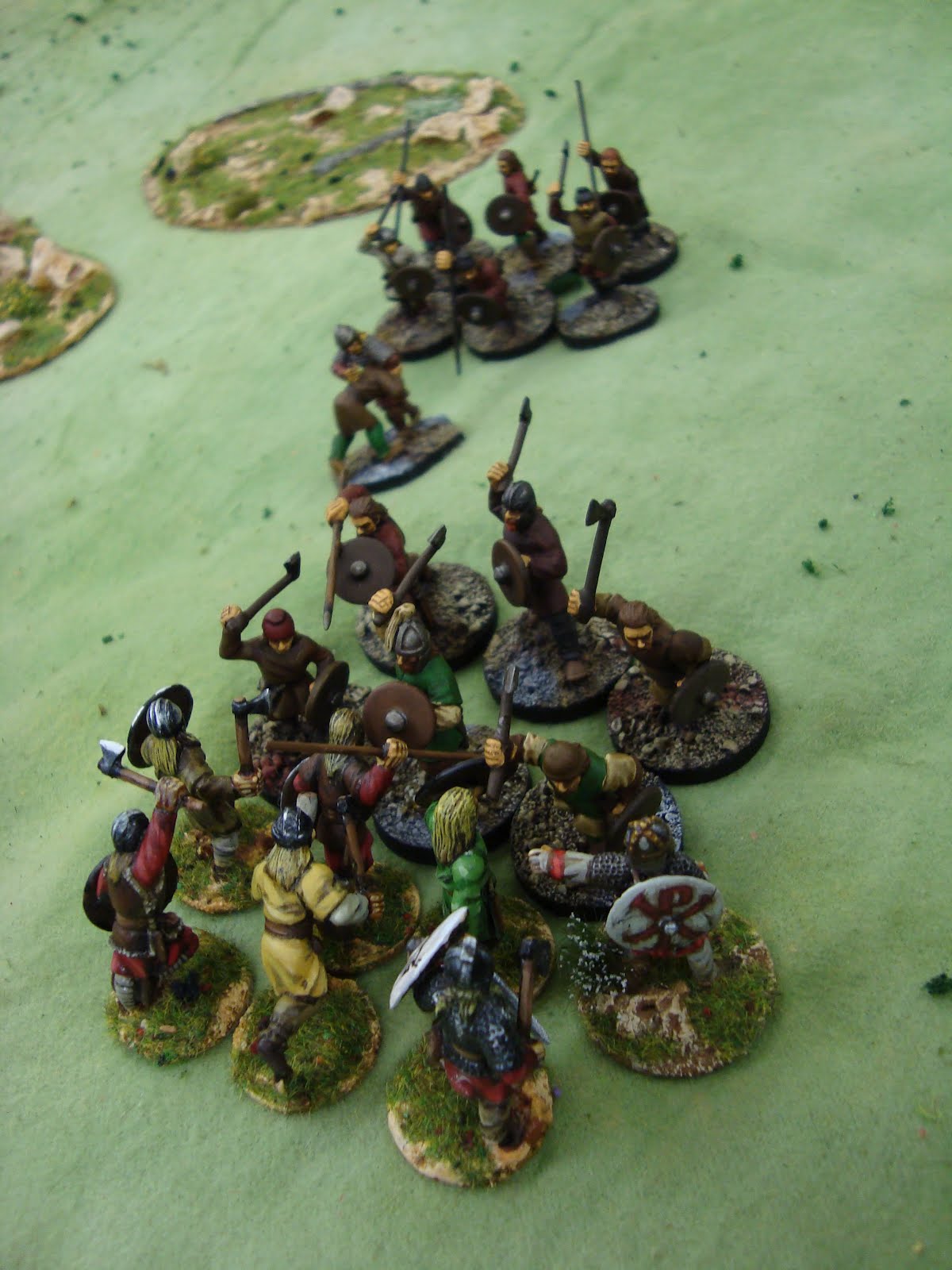
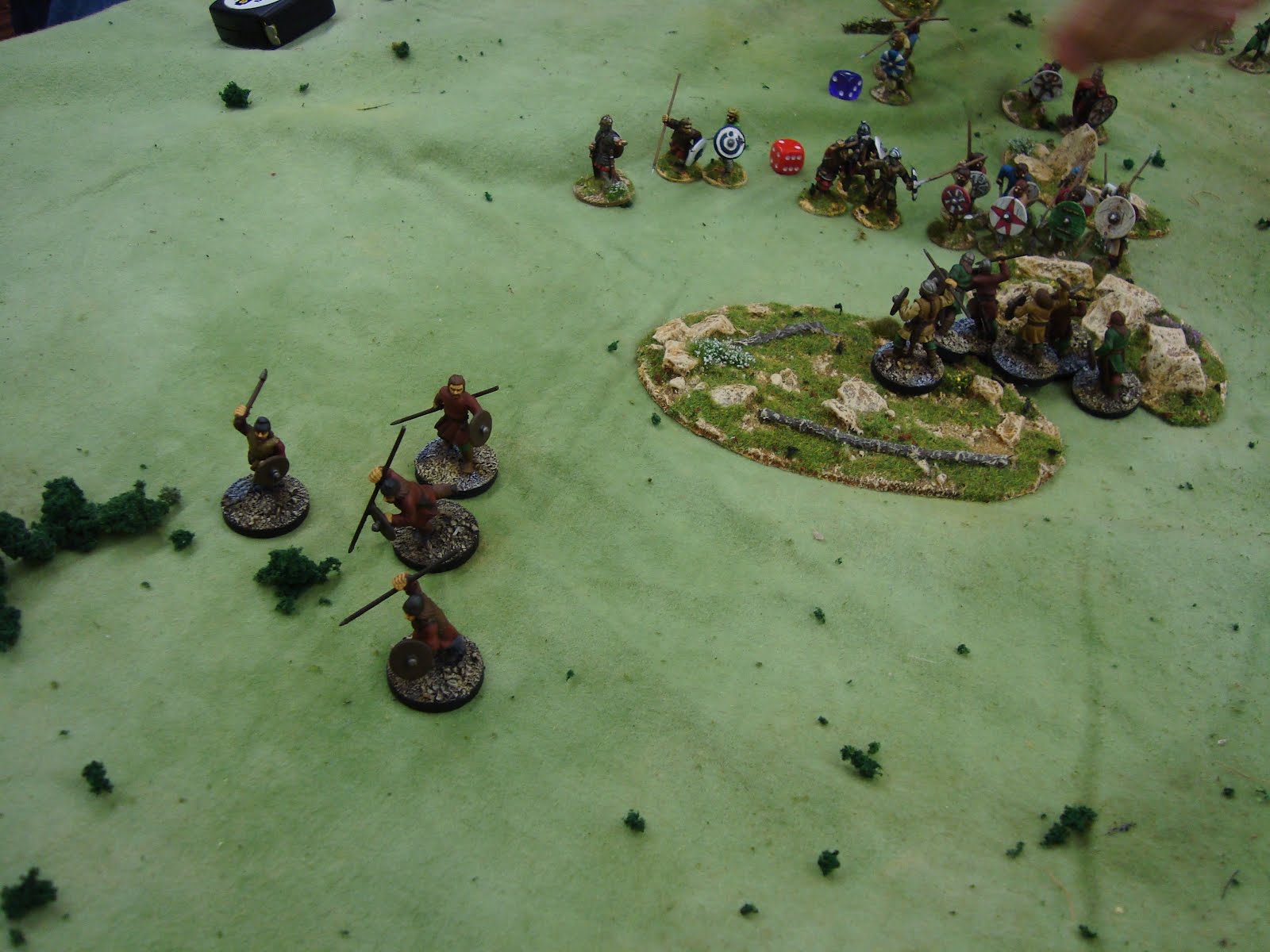
So, there you have it – the second battle report from our ongoing Dark Age campaign set around 5th Century St Albans, and the rival Saxon perspective on Lard-Thane Richard Clarke’s fine pro-British blog from last week. We’re still working on the detailed rules for the battles and campaigns, so it’s a bit early to talk about tactics and mechanisms. But I will say that the second battle really saw some aspects of the game coming together, particularly with respect to the battle between the rival army champions, and the ferocious fighting which focused on the British shieldwall.
The members of my local wargames club are really getting into the spirit of the period, which is proving as colourful and dramatic as I hoped it would.
On the modeling and painting front, I hope to blog the final 25 Saxon figures (actually Anglii mercenaries) shortly, together with one or two extras I hope you’ll enjoy. The next game is tomorrow night, so watch out for the third battle blog report later this week ...
Tuesday, 31 January 2012
Saxon (Psycho) Killers
Following last weekend’s OK (but no better than OK) experiment with the Army Painter strong tone dip, I tried again this weekend with another 20 early fifth century A.D. Saxons. This group included five “Big Men” and also a Saxon champion. The figures were all Gripping Beast, which are slowing growing on me.
Perhaps most fun of all were the “Saxon Killers and Characters” which I used for a couple of the Big Men. These are not particularly for the faint-hearted, although I imagine they’re a fairly accurate depiction of what happened on a Dark Age battlefield (and no doubt on many battlefields since). In the words of the (still-phenomenal) Talking Heads song, "Psycho Killer,... run, run, run away".
As for the painting, I took a lot more time and care painting with this bunch than the group last weekend. Quite a few people posting comments on this blog and at my local club mentioned that colour selection was key. I tried to make sure all the colours were toned together before dipping, selecting browns, reds and greys as the key colour themes.
I tried to shade the bolder colours before dipping to create a little more depth than was created on the previous batch of dipped figures. As before, I didn’t highlight any colours, reasoning that this could come later, post-dipping. I also spent a little time on painting in eye sockets and (on a couple of figures) some face detail.
I also tried a different approach with metallics, painting first with very dark Vallejo gunmetal (mixed with Vallejo black) and then highlighting with plain Vallejo gunmetal before the dip.
I dipped as before, brush-painting from the Army Painter strong tone dip tin as opposed to actually dipping the figures in. As before, the immediate post-dip stage looked hideous. But at least I was expecting that on this occasion.
I applied the matt varnish and was reasonably pleased with the results. They looked better as a group than last weekend’s figures and seemed to “gel” together more. I think the pre-shading of the bolder colours helped a bit with this.
So, on the plus side, 20 figures in a weekend to a tabletop standard, and 50 in a fortnight, was a reasonable result. I put nowhere near as much effort into these as into other figures which have appeared on this Blog.
On the minus side, they are still very much the ugly cousins of other Bloggers stunning and beautiful Dark Age work on the Blogosphere and internet generally. To try and elevate them from “ugly cousins” to anything memorable, I’ll need to do some highlighting, add some shield transfers and some banners. A project for the coming weekend, perhaps. As Benito so very wisely said in his comment on my post last week, it all comes down to effort in the end!
As to how the “ugly cousins” and the Saxon psycho-killers fight on the tabletop, I shall be seeing in about 7 hours time when we play our next Dark Ages game.
If you have a soft spot for psychotic Saxons, wish me luck!
Perhaps most fun of all were the “Saxon Killers and Characters” which I used for a couple of the Big Men. These are not particularly for the faint-hearted, although I imagine they’re a fairly accurate depiction of what happened on a Dark Age battlefield (and no doubt on many battlefields since). In the words of the (still-phenomenal) Talking Heads song, "Psycho Killer,... run, run, run away".
As for the painting, I took a lot more time and care painting with this bunch than the group last weekend. Quite a few people posting comments on this blog and at my local club mentioned that colour selection was key. I tried to make sure all the colours were toned together before dipping, selecting browns, reds and greys as the key colour themes.
I tried to shade the bolder colours before dipping to create a little more depth than was created on the previous batch of dipped figures. As before, I didn’t highlight any colours, reasoning that this could come later, post-dipping. I also spent a little time on painting in eye sockets and (on a couple of figures) some face detail.
I also tried a different approach with metallics, painting first with very dark Vallejo gunmetal (mixed with Vallejo black) and then highlighting with plain Vallejo gunmetal before the dip.
I dipped as before, brush-painting from the Army Painter strong tone dip tin as opposed to actually dipping the figures in. As before, the immediate post-dip stage looked hideous. But at least I was expecting that on this occasion.
I applied the matt varnish and was reasonably pleased with the results. They looked better as a group than last weekend’s figures and seemed to “gel” together more. I think the pre-shading of the bolder colours helped a bit with this.
So, on the plus side, 20 figures in a weekend to a tabletop standard, and 50 in a fortnight, was a reasonable result. I put nowhere near as much effort into these as into other figures which have appeared on this Blog.
On the minus side, they are still very much the ugly cousins of other Bloggers stunning and beautiful Dark Age work on the Blogosphere and internet generally. To try and elevate them from “ugly cousins” to anything memorable, I’ll need to do some highlighting, add some shield transfers and some banners. A project for the coming weekend, perhaps. As Benito so very wisely said in his comment on my post last week, it all comes down to effort in the end!
As to how the “ugly cousins” and the Saxon psycho-killers fight on the tabletop, I shall be seeing in about 7 hours time when we play our next Dark Ages game.
If you have a soft spot for psychotic Saxons, wish me luck!
Wednesday, 25 January 2012
In the Year of Our Lord 452 A.D.
In the Year of Our Lord 452 A.D. there came a terrible host of Saxons from their lands to the south, sailing up the River Colne from the Great River. They were led by a leader, Sidic, the wolf of the southern strands and notorious seafarer of the Grey Waters.
In Sidic’s host was a champion, Wulfstan, who the men of Verulamium greatly feared for he was cruel and mighty. Sooner would his flesh become food for ravens than he would approach an altar and bow before our True Lord.
Before the gates of Verulamium the host of Sidic stopped. The walls remained after the Romans had left. This masonry was still wondrous; fates had not yet broken it. The works of giants had not yet decayed. Under the columns stood the leader of Verulamium, Maxim Boice. Armed he was in the noisy combat. Amber wreaths encircled his brow and a purple cloak comforted his shoulders. Large was his retinue, the men of Verulamium, laughing as they moved, although fearful of a gloomy disaster before the Saxon foes.
Great was the quantity of spears who watched Wulfstan ford the dark waters of the Colne, preparing food for the ravens, slaughtering as he stalked. Splintering the shield of his enemies, women wept as he passed. None in the Verulamium host could stop him until a soldier of Britain, Mullard ap Artur shattered his shield.
There was food for ravens, and for the raven there was profit as Wulfstan fell in the Colne, his head severed by Mullard ap Artur’s sword. Furious were the Saxons. To drinking of mead they fell in gloomy despair. Black fury became anger as the words of their fell priest came to their ears
Silent the men of Verulamium watched. Of their leader, Maxim Boice came little but words of high pitch, reedy and soft. His words of battle were lost as the sound of Saxon arrows filled the air on eagles feathers, keening for prey.
Battle-mad with the death of Wulfstan burning their eyes, Sidic’s host marched with speed, regaled with mead; great was their design. Retreat was their poison, battle their desire. No mother’s son nurses them.
A conflict on all sides befell the bitter field. Saxon and Briton fell together in violent slaughter. Punishment the Saxons sought on their enemies, but the wall of shields of Maxim Boice stood fast. Sword and spear shattered upon wood and iron.
A violent thane, Brytnoth the Saxon, led his men first, eager in battle with eyes of a serpent. Under the helmet of his terror, his men died impaled on bright spears.
Sidic came to his aid, blood draped his cloak from many winters of fighting. With a bold shout he pierced the wall of Maxim Boice, the lion of Verulamium.
Blessed conqueror, Maxim Boice, of temper mild, the bone of the people, with his battle streamer displayed was victorious. There was grief and sorrow upon the Saxons as they went back to their boats. Those boat pirates who meddled with the mane of a lion did not return until the next summer.
****
So, there you have it. One of the forgotten battles of the Anglo-Saxon Chronicle recreated in all its glory at the Fleetville Community Centre, St Albans, England last night. It was the first game my local wargames club has done set in the Dark Ages and it was really entertaining. Especially fun was the way in which each side's forces had to be inspired to take the field through a mixture of excessive alcohol, the revealing of good (or bad) omens and through encouraging (or, as proved to be the case from Maxim Boice, downright awful) speeches.
It’s much too early to say much about the rules we were
Lard-Thane, Richard Clarke, has also posted a far more erudite look at the challenges and rewards of wargaming Dark Age England at Lard Island News. For those interested in the period, I highly recommend you have a read at Richard's blogpost here.
We’ve scheduled a follow up game for next week in 453 A.D., so stay tuned!
Subscribe to:
Posts (Atom)