Monday, 9 September 2013

The Verdun Project: Gas-masked Veteran French Infantry

Just a quick update regarding the French veteran infantry I've been putting together. I had a good deal of fun on the first couple of sections, and I decided this weekend to add another two sections to make a full platoon. To make things a little more interesting, I decided to convert the two new sections to wearing the M2 gas mask. This was one of those "good ideas at the time", although hopefully I have not done too much damage to the figures concerned.


You'll remember that at the start of the year I grumbled a little that no manufacturer brought out late War French infantry wearing the M2 gas mask except Old Glory. Sadly, even the resourceful folk over at Gripping Beat and Forgotten & Glorious Company of Art haven't got around to making head swaps wearing the M2 gas mask. 

N'import, mes braves!  The French M2 gas mask is pretty easy to replicate in miniature (at least at a very basic level - which is, yes, my level!). It consisted of a single piece of material covering the whole of the face completely. The material had the same function as the filter cartridge on other masks, effectively neutralising the effects of gas. The M2 was used by French troops from April 1916 until August 1918, making it perfect for the forces I've been building up for Verdun. It seems that the M2 was effective for longer periods of time, even up to five hours, probably owing to the full-facial covering being slightly more comfortable and effective than some other masks during 1916.


Making the M2 mask on a model is simplicity itself. First, file down, or cut away the facial features on the model. It goes without saying that some care is needed here as you want to try to avoid damaging the remainder of the model. It helps if the face is left rough and not sanded down too fine, as the putty mask can adhere better.  Cutting, filing and sanding away to the edge of the helmet strap (if possible and if worn) seemed to me to be a good compromise. What seems like a fun procedure on one figure rapidly becomes a bit of a chore when you're doing 22 of them.  Your fingers will not be thanking you once you've done a couple of sections!


Next, mix the modelling putty of your choice and apply a flattened blob to the face of the model. I used "grey-stuff" and "brown-stuff" putties on the figures here - but "green stuff" should be fine as well. Manipulate the putty into place and sculpt to taste - that's the mask done.


The eyepieces are formed using a very small blob of putty. I found this easiest to cut from a blob on a flat surface, so you can be sure of taking a similar amount each time. Roll the tiny amount of putty into a ball, and add to the mask surface, then flatten and press the glass eyepieces with the blunt end of a modelling drill bit.  Keeping the modelling tool you're using wet helps the putty not sticking to the blade.


And yes, you do that 44 times - one for each eyepiece. It gets a bit boring by the end. However, after 44 eyepieces….you're done! That's it! You've now got a couple more hardened or veteran infantry sections with M2 gas masks. I also added a casualty figure in a gas mask for an additional, slightly grim, touch.


Leading on from my last post on the veteran infantry, I've also added a couple of photos of head conversions, trying to show the process for removing a figure's Adrian helmet before removing the figure's head. That way you get ahead swap, and also a spare helmet to fix to the back of the field packs of your other troops. Simple, but I think it looks quite nice.


Of course, all this could have been avoided by some enterprising manufacturer bringing out a more "campaign look" set of French figures wearing M2 gas masks.  But where's the fun in that?

Wednesday, 4 September 2013

Donald Featherstone – Rest in Peace


Another very sad day yesterday, with Donald Featherstone, the father of modern wargaming, passing away. I never met Don, although his personality shone through his books which were a huge influence in my, and no doubt, many other wargamers’ lives.

From the very fine tributes from a number of other wargames bloggers this morning, I know many, many others – Nate, Conrad, Lee, Bob, Mike and Grimsby Mariner – feel the same way.

Like many other wargamers born in the late 1960s, I grew up in the age of school wargaming clubs and the wonderful British public library system. When I think back, it’s hard to separate the two. I used to wargame at the School club on a Friday evening, and cycle down to the local public library before it shut at 7pm to swap last week’s library books around. I was very fortunate – the Hull librarians had the forethought to purchase many of Don’s books for the shelves (located somewhere around 793.3 in the duo-decimal system).   “War Games”, “Solo Wargaming”, “Advanced Wargaming”, “Skirmish Wargaming” – the list went on, and by cycling around the libraries in Hull, or using the inter-library loan exchange, I ended up reading almost them all by the time I left school.


The one which has a special place for me is “War Game Campaigns”. It’s a magnificent book, full of insight and the lure of wonderful campaigns of all sizes in different periods and places – some exotic, some close and familiar. I was simply beside myself when I bought the copy from my local library in 1988 for the princely sum of 25 pence!


I read a chapter or two now and again – sometimes for nostalgia, sometimes for inspiration, and sometimes for the sheer pleasure of reading something so clear and masterful by one of the giants of the hobby.


It’s hard to think of my hobby without Don Featherstone.

Thank you Don for helping me to build a lifetime of wargaming pleasure with my friends.

Rest in Peace.

Monday, 2 September 2013

The Verdun Project : “German Strategy and the Path to Verdun” by Robert Foley


“German Strategy and the Path to Verdun” is a clear, well-presented study by Robert Foley of the strategic options facing Erich von Falkenhayn, as German Staff Chief, during 1915 and 1916. Dr Foley’s book culminates in the battle of Verdun, but the greater part of his work examines the competing strategic theories and demands on the German High Command which led to the decision to launch the Verdun offensive and prosecute that offensive in a unique manner.

 
I’d recommend the book to anyone interested in obtaining a greater insight into German strategic theory in the First World War, Falkenhayn and his command objectives and the battle Verdun in particular.

The first part of Dr Foley’s book is an intricate and detailed study of different and competing themes within German military and strategic thought in the period between 1870 and 1914. The section focuses on strategic doctrine and military academic studies. The competing strategic doctrines of Exterminationskrieg (war of extermination), Vernichtungsstrategie (strategy of decisive victories) and Ermattungsstrategie (strategy of attrition) are clearly compared and distinguished. Foley’s argument is, very broadly, that during the 1870 to 1914 period the general tenant of German strategic thought was to seek a war of decisive victories, mirroring the campaign of 1870, and with recognition of the wars of Napoleon as their lodestone. The aim was to achieve “the war’s decision in a few mighty strokes; a peace in which the defenceless enemy was forced to accept the conditions of the victory without demur” (page 41). The apex of this strategy was represented in the Schilieffen Plan, the German strategic manoeuvre used in the event of a war with France. Decisive, crushing and dramatic, Vernichtungsstrategie was a strategic vision well suited to the late 19th century themes of nationalism and struggles between nations.


The second part of the book deals with the evolution of the competing German strategic theories in the light of the Russo-Japanese War and the experiences of the opening months of the First World War. The transition in the German high command from von Moltke the Younger to Falkenhayn is covered, together with a detailed examination of Falkenhayn’s strategic vision of war by attrition in the context of Ermattungsstrategie. I found this the most interesting section of the book, and a very subtle evaluation of Falkenhayn’s merits as a supreme commander. Essentially, Falkenhayn’s strategic objective was, Foley argues, based around convincing one of the major Entente powers (France, Britain or Russia) to accept in 1915 that the price of continuing the First World War was too great to pay. This led, in turn, to a focus on the Western Front as the place most likely to achieve that strategic objective (though defeating France and thereby knocking “Britain’s best sword [France] out of its hand”; page 187). This strategy would be complemented by a continued vigilance against Russia on the Eastern Front, together with a determination to achieve a diplomatic resolution through an armistice or capitulation of one of the Entente Powers. This part of the book identifies the complexity of German strategic thought in 1915, and also indicates the seeds of its own failure in 1916.


The third section of the book (from page 181) covers the offensive around Verdun. Foley places Verdun very firmly as the culmination of Falkenhayn’s strategic journey. From the inception of the battle, the Verblutung (or “bleeding to death”) of the French Army was Falkenhayn’s aim. Although the existence, or otherwise, of the Verblutung as a strategy has been vigorously debated (not least in German military and academic circles between the Word Wars), Foley makes a very convincing argument that the Verblutung was Falkenhayn’s aim at Verdun from the start. The methodology is chilling: “During an attack from the north and the east, the [French] positions will soon be so diminished that not even a mouse can live in them” (page 190). Verdun was chosen as a location on the Western Front which the French would defend vigorously. Falkenhayn made his decision to cite the battle at Verdun with considerable insight, with the French high command seeing the city as too important to cede to the Germans irrespective of the appalling casualties suffered.

Reading “German Strategy and the Path to Verdun” alongside Ian Ousby’s “The Road to Verdun” (which gives the French nationalist and strategic objectives for the battle, and which I reviewed in January HERE) provides almost all the answers as to why Verdun became such a titanic and horrific battle.


The fourth and final part of the book deals with the aftermath of Verdun, the failure of Falkenhayn’s strategy and the abandonment of Ermattungsstrategie. Above all, Falkenhayn was unable to discern that the First World War was not merely a struggle of nations in the context of the Napoleonic Wars or the Franco-Prussian War. It had become an almost total war, in which whole populations and industries would be harnessed as never before in a struggle to hold on at all costs, demanding previously unimaginable sacrifices from the combatants concerned. That transition in the nature of the First World War made it impossible for any Entente Power to even contemplate coming to terms with Germany in 1916, thereby condemning Falkenhayn’s strategy to failure.

Coupled with this fundamental transition in the nature of warfare, was the inability of the German High Command to achieve a consistent tactical solution at Verdun to breakthrough the French defensive positions.


For any wargamer interested in the origins of the battle of Verdun battle, Dr Foley’s book is excellent. It is written in a clear style, with helpful summaries at the end of each chapter. Although the themes are complex and sometimes dense, I sensed that Dr Foley appreciated this and was determined to write in a style which reduces that complexity to a manageable narrative. As I suggested before, the book really comes into its own when coupled with other books on Verdun, particularly Ian Ousby’s “The Road to Verdun” which focuses on the French experience of the battle.

There is not a great deal in “German Strategy and the Path to Verdun” about the nature of the fighting in the battle itself. But this is not an operational history. This, above all, is a book about the strategy of fighting a war, and how that strategy evolves and, in this case, can fail.

For a wargamer interested in the Great War, strategic thought, or the battle of Verdun – 5 out of 5 star shells, and highly recommended. For other wargamers, I’d say it’s a very worthwhile read – so 4 out of 5 star shells.

Wednesday, 28 August 2013

Chain of Command Campaign: Game 1 - "Patrol"

18.45 hours: 

Second Lieutenant Sandy St Clair looked at his watch. He’d given up believing the time shown on the watch-face two days after D-Day. It was his nerves making him look. He knew that. But he couldn’t stop twisting his wrist and staring at the monochrome dial he’d bought in Bow Lane a lifetime ago. Each time he looked, he felt as if it was more of a wrench to look away and remind himself where he was.

He could taste the battle in his mouth. His face was inches away from the dry earth, body flattened hard against the Normandy ground. His tongue registered the dirt and soil on his lips, mixed with the smoke and stench of a day old battle. Somewhere in his mouth was the tang of burnt scorched metal from the German tank left in flames half a mile back. It mixed in an unholy cocktail at the back of his throat with the charred, blackened, half-nightmare smell of the bodies in the ditch a few yards from his side.


18.46 hours:

How could half a minute have passed so fast?

He felt the whisper at his side of his platoon sergeant, fingers jabbing forward up the road, the jingle-jangle of his platoon’s equipment deafening after the few minutes silence. Crouching, then moving, head down, his legs felt like stone as he rose and walked to the hill crest overlooking the Church his platoon scouts had located twenty minutes earlier. Why wasn’t it marked on the map? Where on earth was he anyway? Nothing seemed to make sense in the close hedgerow terrain. He looked at his watch again.

And he looked at it again, just one more time.


18.47 hours:

He was sweating in the dusk sunlight, now watching the church from the hill-crest through the cloud of mayflies above the ripening barley. He could see ghosts in the hedgerows. They were wearing field-grey tunics and camouflaged clothing.


“Now in my dial of glass appears

the soldier who is going to die. 

He smiles, and moves about in ways 
his mother knows, habits of his.
The wires touch his face: I cry 
NOW. Death, like a familiar, hears”

Still 18.47 hours

He watched the other section of his platoon spreading across the road, and looked back to his men, following. Looking at him. Looking to him. He waved the Bren team to the front, hands working urgently. He caught a glimpse of the time on his wrist. He felt he had to look again, quickly, and check just one last time, watching the second dial moving. He resisted the urge, crouched down and signalled to the mortar crew. He checked his watch again as the first smoke round fell in front of the Church. The second hand on the monochrome dial had hardly moved.


18.48 hours:

His head was screaming, filled with the evil chatter of the Bren team’s gun ripping and wickering into the stone wall of the Church, smashing the Gothic window. He saw the stained glass break but never heard it smash. He was too busy running for the hedge. He was screaming as he lunged into the thick, wiry, clawing brambles and gorse, his hand pinned almost in front of his face. The first thing he saw was his watch face. He wasn't sure of whether his watch was just there, co-incidentally, in front of his face or whether he had been frantically searching for it.  Another 15 seconds gone.


18.49 hours:

He’d shouted himself hoarse by the time he’d seen the section creeping towards the hill-crest of the neighbouring hill. Stalking, slowly, up the chalk down.


He had more to look at to his front, as he watched keenly, eyes streaming from the smoke falling all the time from the mortar around the church. Were They still in there? Were They even there at all? His head was pounding and he looked at this watch again.


Still 18.49 hours:

Stop staring at it! Look up! Stop staring at it.

He looked at his watch again.  Something inside him squealed and wanted to tear his hand off and the watch with it. He looked up.

He saw the section still crawling, crouching, moving on the other hill. What was on the other side? The map was useless now, and he could see nothing through the field glasses. Lenses held to his eyes, a world of grey mist and chemical smoke. He wished he was there in that grey world of fog and shadow, or anywhere, rather than here.


18.50 hours:

He heard the ambush on the neighbouring hill, rather than seeing it. The sound of the MG42 tearing through the hillside was almost as distinctive as the sounds of the German hand grenades. He waved frantically at his Bren team to change targets, hoping they could see the Enemy.


He noticed his field glasses were shaking as he watched the remnants of the broken German section running for cover before more chemical smoke drifted across the lenses and made him retch. Was it just the smoke which was making him retch? What was wrong with him?


18.52 hours:

He checked his watch again. His hand was still shaking. He signalled for the Bren team to cease fire at the Church. And waited.

He watched the second hand on the monochrome dial crawl around the watch-face as the stench of battle slowly filled his mouth again.

****************

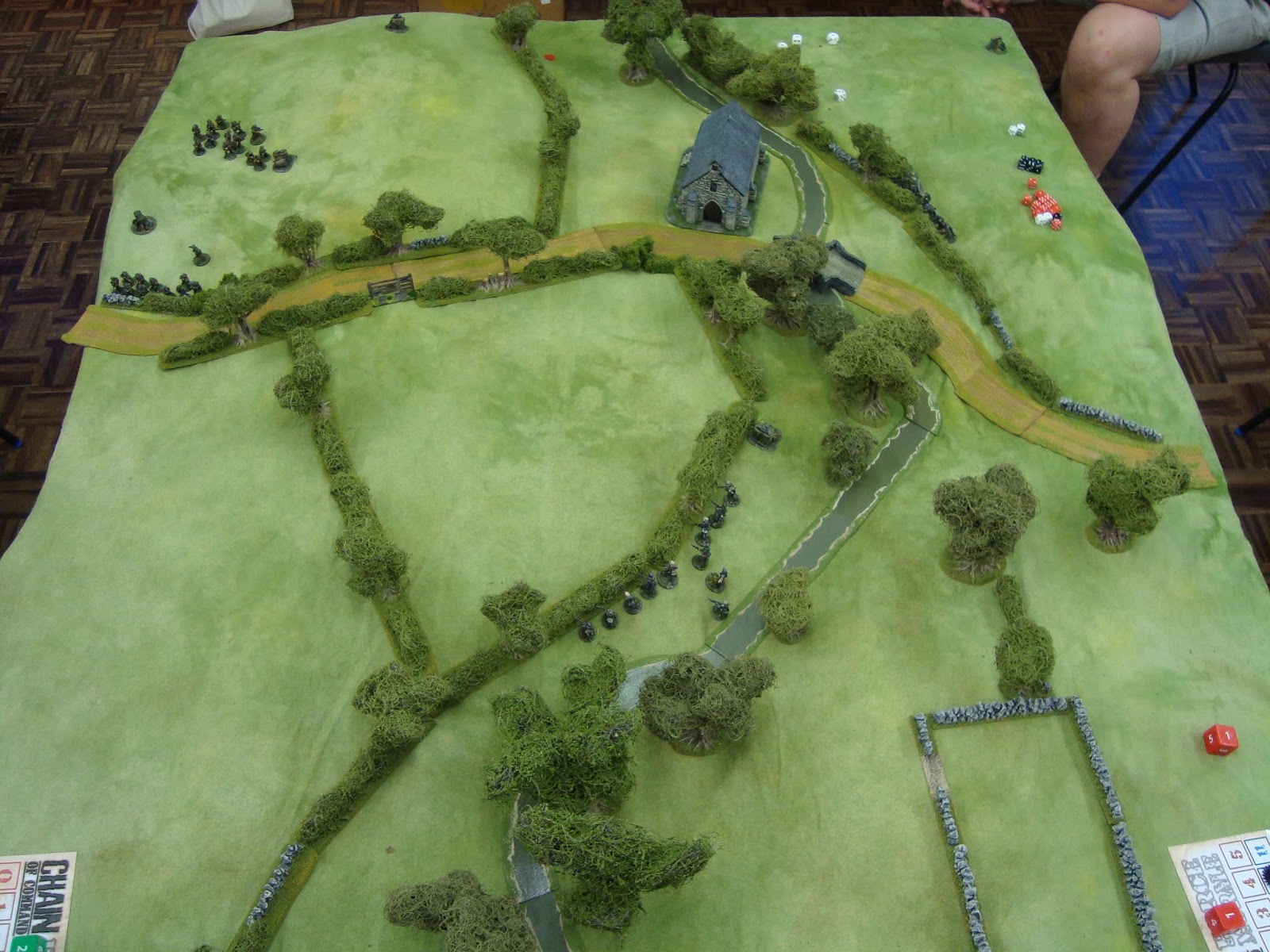
This was the first game in our “Chain of Command” campaign set in Normandy, three weeks after D-Day. The game was taken from the Chain of Command rules, being the Patrol Scenario in which two small forces probe against each other’s front lines. it was a tight, hard game, fought cagily between the two sides. I tried, with Big Al as the other British leader, to keep in mind the fire & movement tactics of the infantry training manuals Richard had passed to me a couple of weeks ago. But sometimes, ambushes are hard to spot! We had the dice on our side in the main firefight, with the losses inflicted on Panda's German force eventually breaking their morale and pushing the Germans back to their outpost lines.

I’ll try and post a game each week as we fight through the campaign over the next month or so. It'll be interesting to see if Lieutenant St. Clair’s nerves can hold on. 

The extract from the poem is from “How to Kill” from the excellent Keith Douglas, killed in action on the 9th June 1944.

Monday, 26 August 2013

The Verdun Project: French Support Weapons and Veteran Infantry (Part 1)

I’ve wanted the French forces I’m building up to be accompanied by a few support weapons. A number of these were critically important at Verdun, and in the later French offensives of 1917 and 1918.

Unfortunately, the modelling choice of support weapons in 28mm is not very extensive. Its really a question of assembling the support elements from a variety of manufacturers, and bringing the different weapons together as a unified force by similar basing and painting techniques.

I wanted in this post to give an overview of the figures available, and also give a bit more of an insight in converting late Great War French figures. Please bear in mind that I’m very far from a great military modeller, and the bulk of conversions are really just to add some variety into the French forces I want to field on the wargaming table.  I also thought that a couple of insights into how th various 28mm model kits fit together might be helpful.

First up, is “Le Soixante-Quinze”....


Errr….not quite, although the cocktail of the same name was created in 1915 at the New York Bar in Paris, supposedly because the effect of the drink was felt by stunned Parisians to be a little like being shelled at the front! 


No, the “Soizante-Quinze” I’ve been focusing on is the famous French 75mm artillery piece, used widely in the French army during the War but only really effective against targets which were not deeply entrenched owing to its low trajectory of fire. The brace of 75s I’m building are from Scarab Miniatures. I’ve had these for a long time, and they’re undoubtedly a handsome pair of models – although not without some difficulties in construction. Unfortunately, the gun shields are not quite accurately modelled, in that the gun shield aperture is slightly wider than was used in late war version of the gun.  I think I can live with the slight difference though.


Pinning the barrels onto the gun carriage is, I think, recommended.  The 75 had a long barrel which does not balance well on the carriage in the model version without some strong suport.  Pinning through the gun carriage and into the underside of the barrel really helps in this regard.  Also the gun wheels are very narrow on the model – and while this is accurate, the model needs careful and delicate handling at all times once assembled. 

Fixing the gun shield in place needs a lot of care. There are no orienting lugs on which the shield can be glued onto the carriage, and the gun shield is too thin to pin effectively. I therefore opted to fix a block of blue styofam under the carriage to give the gun shield something to attach and glue on to. This seems to have fixed the shields in place firmly, and hopefully the Styrofoam block should be invisible on the finished model once painted.


Here’s the assembled guns with Brigade Miniatures’ late War gun crews (to match with the French Infantry I’ve been painting).


You’ll see that the base work is undulating. This is intentional, and helps the ground support the slightly flimsy gun wheels and provide a bit more base for the wheels to be glued to when finished. Although the undulations look prominent in the photos, they should (fingers crossed) be virtually invisible when the bases are painted and the groundwork finished.


Next up, a brace of heavy machine guns. First, a captured MG08 on a sled mount being crewed by French gunners, and second a Hotchkiss Mle 1914. I forget where I picked the MG08 from, but it fits very well with the Brigade Games’ gunners. It wasn't unheard of for French gunners to have captured German machine gun positions and to have turned the guns on their former owners (I’m sure that the same was true in reverse – some German stosstrupps certainly used the French Chauchat light machine gun because of its weight and ease of deployment).


The only additions I’ve made to the models and the gunners are to fashion some ammunition belts for the MG08 and an ammunition strip for the Hotchkiss, both of which can be added when the figures are painted. The ammunition strip was made from thick foil from a wine bottle (not sure which vintage!), with the “bullets” being “grey stuff”. You can actually buy some excellent ammunition strips from Jeff at Dragon Forge Design, but I’d run out!


Then I made up another Crapouillot trench mortar from Brigade Games, and a couple of infantry mounted 37mm trench guns from Old Glory. The latter are difficult models to assemble, but were a significant part of French small unit tactics in 1917 and 1918. I pinned the 37mm gun to the ground mount very carefully with fine wire, without which mounting the gun is pretty precarious. The model is worth the (considerable) trouble to assemble, and fits very well for size with Brigade Games’ late War French figures. You may wonder why I didn’t use the Scarab Miniatures’ 37mm trench gun. While the Scarab 37mm is an excellent model, it looks very large alongside the Brigade Games models. It’s a shame that the rank-and-file Scarab models were not cast just a little smaller to fit with the Brigade Games range, but the Old Glory figures are a good substitute.


Last but not least, I’ve had it in mind to build up half a platoon (maybe more) of veteran French Poilu. These could be veterans, Foreign Legionnaires or simply hardened defenders of a Verdun position. I made a few head swaps (replacing Adrien helmets for wounded heads and caps), added a few extra bedding rolls and packs to the “barda” (field packs) of the Poilu, and roughened up the greatcoats of some of the troops. I found that the head swaps worked best with building up the greatcoat collars of some of the figures (but that may just be me as I always seem to make a mess of head-swaps).


I added an M2 gas mask on another prone infantryman accompanying a Chauchat automatic rifle to disguise the slightly mis-cast face on this figure.  As I've mentioned before, producing a reasonable version of the M2 gas mask is very simple in this scale.


I also used the brilliant hand grenade pack from the very highly recommended Victoria Miniatures to swap out the very late War hand grenades cast on the figures with some earlier Foug or P4-style grenades from earlier in the War and which were more suitable for 1916 (as shown in the two photos below).


I also based up my final pack of Old Glory French casualties, this time simply for decoration and without holders for “shock” or “wounds” dice.
 
 
So here’s the infantry force ready to paint. I added a more “front line” command stand, complete with artillery spotter, which is a bit more common-place than the Battalion command stand in full dress I painted last month.


 All I need to do now, is to paint them!
Related Posts Plugin for WordPress, Blogger...