Wednesday, 26 March 2014

“A Mere Question of Pluck”: Talana Hill, 1899


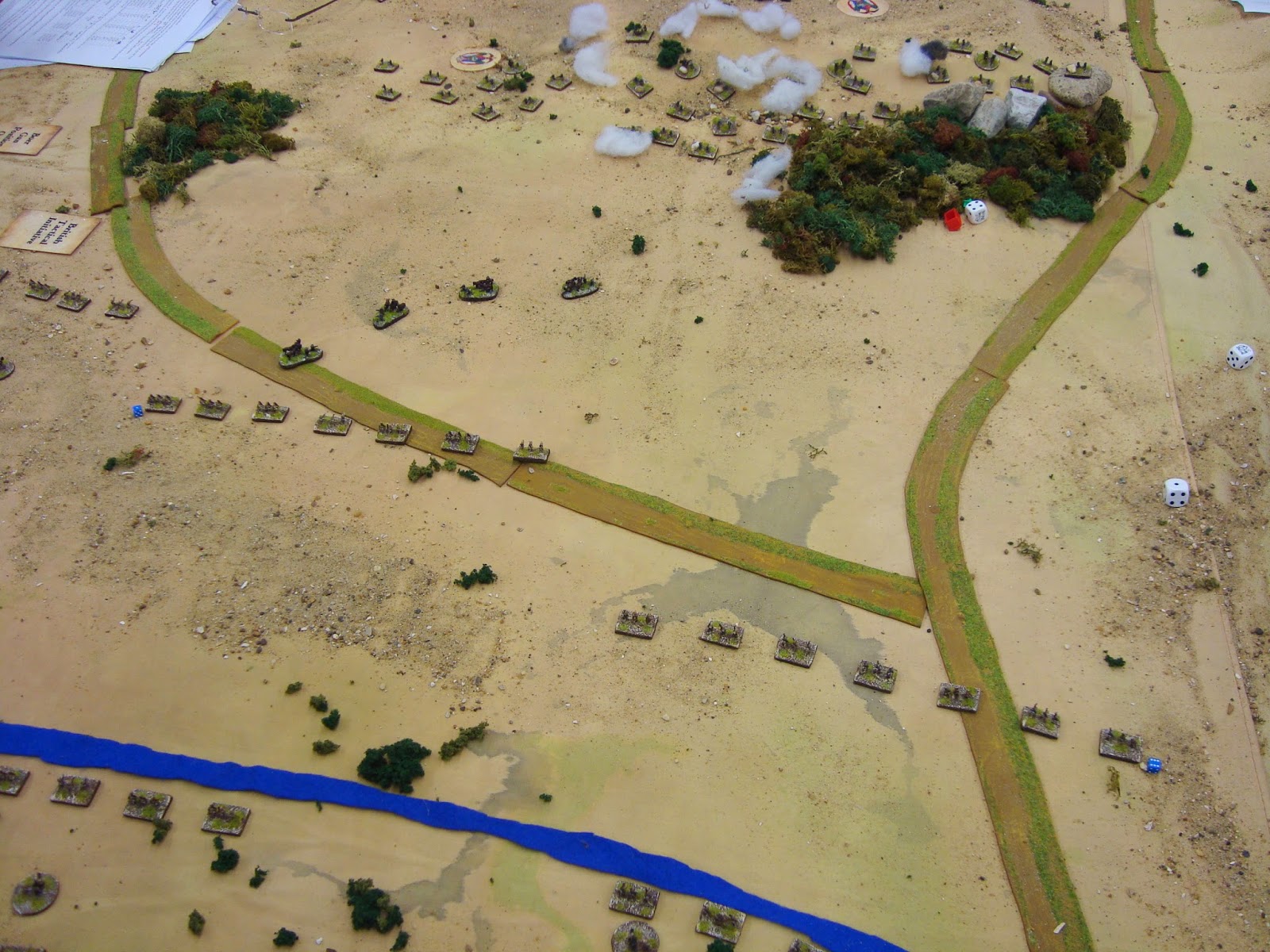
Over the past few weeks, the St Albans club has been returning to the Second Boer War. For various reasons (family illness, work), I’ve missed the first couple of games, but I returned last night for the British assault on Impati Hill, north of Dundee in Natal province.
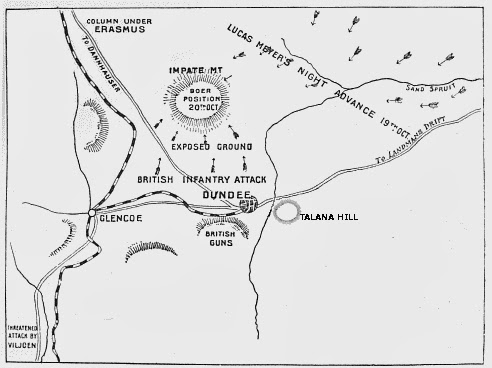

The scale used was the same as in previous games (6mm figures, courtesy of Baccus 6mm, scratch assembled terrain and a ground scale of (approximately) 1 inch to 50 yards). The rules – “A Mere Question of Pluck” were Rich’s own, and are bound to change as play-testing goes forward.

The actual battle was a very close run encounter, and the wargamed recreation stayed true to form. The result, after two and a half tense hours of play, was a marginal British tactical victory, won mainly by the ability of the British infantry to press on regardless of early casualties.

In one of those historical echoes (for which our games of the Second Boer War seem to be full of), the command of Sir William Penn Symons went strangely absent for long periods of the game. This wasn’t the result of a mortal stomach wound inflicted on his command figure (as historically), but owing to the vagaries of the card deck refusing to bring out his command card. At times like this, improvisation is the British watchword, and the infantry advance ground forward remorselessly, but at a initially glacial pace.


Instead of listing the events on this page, I have added a commentary to the photos. Let me know if you prefer this to a written narrative.


Thoughts and impressions.

1.  The Boer Wars are a wonderful period to recreate, with numerous engagements, balanced but very differently configured opposing forces and variable commanders (particularly on the British side).  The sources are numerous and in English.  Some, perhaps many, of the tactical developments foreshadow, or influence, the tactics used in the opening months of the Great War.

2.  The Baccus 6mm figures are admirably suited to grand tactical battles.  They looked perfect on the tabletop.

3.  Integrating card-driven mechanics into the rules is proving interesting.  We are working on a number of variations involving tactical initiative cards - enabling these to be used in certain situations to provide impetus, or rallying, but at the risk that the initiative card may be lost or "burned".

4.  Playing the British forces (particularly infantry) is hard work.  They are somewhat unwieldy in the face of Boer Commando tactics and can be awkward to deploy.  Once deployed and moving, however, they are formidable.  Getting the British infantry to deploy and move forward aggressively is the main drain on the British command.

5.  Playing the Boers requires finesse and skill.  There are numerous tactical opportunities, but the forces are small and fragile if poorly deployed.  British artillery is a killer once finally deployed.


I'll finish by mentioning that we're hoping to run through other Boer War engagements over the next few weeks.  Hope you can join us for those!  


Wednesday, 26 February 2014

The Verdun Project: French Casualties and Bruised Flesh


Just a very quick update, again from Curt’s Painting Challenge and my fourth themed entry. This time, the subject was “Casualties”.


I painted a set of seven fallen Poilu, all in 28mm and from Old Glory, mounted on 40mm round bases from Warbases.

There’s nothing new as regards the basing or the uniform colours, all of which I think I’ve mentioned before on this Blog or posted details in the sidebar Painting Guides.

However, I wanted to try and experiment with a different flesh tone to the figures.


I normally rely on Vallejo Model Colour (VMC) Basic Flesh for my European flesh tone base. But for these figures I wanted something more grey, wounded and mortified.

Instead of the usual skintone, I blended a 50%/50% mix of VMC Green Brown and VMC Neutral Grey for basic skintone. I added a highlight on all of the figures by adding white to the VMC Green Brown/ VMC Neutral Grey mix and layering the highlight on very thinly. I then ink-washed the faces and hands with a blend of Games Workshop’s Asmuren Blue and Gryphonne Sepia. The Asurmen Blue blends the very warm, beige tone of the Gryphonne Sepia wonderfully. I then deepened the recesses with a VMC Burnt Cadmium Red and VMC German Grey mix. I added lighter skin tones over the ink washed skin for the final highlights.

All that sounds rather different from what I normally use for a flesh tone.  I really enjoyed the change. I should add that none of the above paint/ink/colour-tone ideas were my own. I am more than happy to direct you to a wonderful, inspired blog – Spiky Rat Pack – from where all the ideas and paint mix suggestions came from. Kari’s results on his Eviscerator were incredible, and awe-inspiring. Far, far better than mine and I recommend you visit his blog for all kinds of wonderful inspiration. My results were somewhat less so, and I’m not sure that the sickly flesh tone on my figures looks quite right.


 They look suitably wounded and bruised when photographed here, but in natural light on a wargaming table top they do look, well, how can I put it….perhaps just a tiny bit flat? But then again, these figures are supposed to be fallen or badly wounded soldiers - should their appearance be exactly the same as their healthy comrades?  I’m very much open to your thoughts on this, as I see them as being a work in progress to be followed by others.

And I should add that if you’re at the Partizan show in early June or the Evesham wargaming day in late June you should be able to see these casualties (and the other French figures featured here over the last few months) in the flesh, so to speak!

Monday, 10 February 2014

“This Warre Without an Enemie”: The Hartfordshyre Clarion, Edition One

Rumblings of discontent have been heard throughout the St Albans Wargames club for some time concerning the absence of an English Civil War campaign and a suitable set of rules for fighting the period. We tried to pull together some rules about three years ago called “In the Buff” – which hopefully needs no explanation.

These stuttered and limped along through several games, mainly because the period details for replicating push-of-pike and cavalry actions in a set of tabletop wargames rules are tricky. However, a series of emails dropping into my email box over the last few days herald a new club campaign, set in the green and leafy shire of Hertford during the heady days of June 1642.  Excitement is now riding high for another try out of the rules...

As Sir Sidney Foxborough, I’ve declared for Parliament, and raised a stout regiment of Hertfordshiremen in the town of Royston. I will be joined by several Parliamentary luminaries, such as Sir Roger Roughshaft of Rickmansworth (Nick). Against us are ranged the forces of the King, including Sir Rufus Leaking of Tring (Elton), Lord Seymour Organs (Rich), the Rt Honourable Sir Harden Thicke of Watford (Biffo) and Sir William Ramdin (Trev). I hope you’ll agree that this collection of names stirs more disdain than terror into the hearts of the Parliamentary armies, but we shall see how they perform in the field.

Not content with regaling us with (emailed) tales of supposed martial prowess, Lord Seymour Organs appears to have commandeered a rudimentary printing press to libel his opponents, as you can see from the newssheet below.


I have arranged for my own printing press to be shipped from Emden by express fluyt to counter such vile lies and tell the truth through England concerning the King’s poor counsel.


I'll let you know once my wordsmiths have crafted their witty response....

Tuesday, 4 February 2014

The Verdun Project: The "Heroes" of Fort Douaumont

Continuing the Verdun theme, here’s some photos of my entry in the “Heroes” themed category for Curt’s Analogue Hobbies 4th Annual Painting Challenge.


Things have been pretty hectic throughout January at Roundwood Towers. I had a big project to finish at work which took a lot of time, and which now (thank the Lord) is finished. A good result for the client, but more importantly I could reunite myself with my family and have some sleep!

I’d originally intended to something aerial for the “heroes” theme. I got very excited, bought the aircraft kits, but time and real-life conspired against me. Is that the sound of violins playing in the background? No, no, mes braves – you’ll not have regrets and complaints at this blog. Nothing lost – merely another fun project postponed.

And with that aerial postponement, I got the chance to try and think of another “heroic” subject. I've always loved moments of military history which turn out, with the benefit of historical hindsight, to be slightly different to what everyone thought when first they become known. So, with that in mind, here's a classic group of German assault troops, led by Oberleutnant Cordt Von Brandis, commander of the 8th company of the 24th Brandenburg Regiment at Verdun in 1916. 


The figures are my attempt at replicating the famous storming of Fort Douaumont, a remarkable feat of military daring which was almost a body blow to the French nation in February 1916. Von Brandis became extremely famous, met the Crown Prince of Germany, had a village named after him, formed “Freikorps Von Brandis” in January 1919, and wrote his memoir of the adventure in 1917.


A true hero, in the classic mould. A young, 27 year old Teutonic hero, with a firm soldierly jaw. How heroic. Surely a wonderful subject for a themed diorama…


Apart from the fact that by the time Von Brandis had actually arrived at Fort Douaumont it was already under German control thanks to the pragmatic and fast thinking action of a much more down to earth Thuringian Feldwebel, Sergeant Kunze. The good Sergeant clambered through a carelessly unsecured window, and captured the French garrison, almost without a shot being fired. Sergeant Kunze survived the Great War and became a police sergeant, waiting patiently for 20 years for the real story of the fall of Douaumont to be told.

And so the legend of the storming of Fort Douaumont was born, proving once again that heroes come in all shapes and sizes!


Monday, 27 January 2014

British, German and Updated French Late Great War Painting Templates


Just a very quick update to let people know that I've updated the late Great War French painting template, which is available on the right-hand toolbar of this Blog under the heading "Playtesting Scenarios, Campaign Diaries, Play-Aids and Painting Guides".   Hopefully everyone can get easy access through Google Drive - but as ever, please let me know if there are any problems downloading it.

I've been hard at work painting a demi-platoon of hardened, veteran  French infantry over the weekend for Curt's excellent Painting Challenge, and I thought there were a couple of useful additions I could make to the template which I first posted in May 2013.

I've also added a late Great War British and late Great War German painting template as well.  Both are long overdue, so I hope someone out there finds them useful.

Thanks also for the kind feedback regarding the Operation Gericht participation game for Partizan MMXIV and Evesham later this year.  I'm hoping to post some material on what we have planned during the course of this week and next.

Friday, 24 January 2014

Operation Gericht: Partizan MMXIV and Evesham, June 2014

For those of you who like to plan ahead and (hopefully) have something to look forward to, here’s a bit of advance news.

Richard Clarke, myself and some other members of the ToofarLardies team will be taking a participation game on the road to a couple of wargames shows this year. We’ve kindly been given an invitation to Partizan MMXIV in Newark on 1 June 2014. We’re also going along to the gaming day organised by the Evesham wargamers on 14th June, entitled “The Lardest Day”.

As for the subject of the game, perhaps it’ll not be a surprise that it’s Great War themed. Here’s a big clue to the subject and the setting for the game:


I’ve not got many more figures left to paint for the game, but there is some modular terrain to build and some hand-outs to prepare. 

And don’t worry, I’m hoping to post the progress here over the next few months.  Hope you can join me for that, as well as the remainder of Curt's splendid Painting Challenge...

Friday, 10 January 2014

The Verdun Project: French Grandes Hommes in “Through the Mud and the Blood”


As promised, I’ve uploaded a couple of items on the Blog this evening. I’ve meant to place these items on the Blog for a while, and I hope you enjoy them.

The first is an 11-page hand-out entitled “Les Grandes Hommes: Backgrounds for French Big Men in Through the Mud and the Blood”. As I mention in the introduction to the hand-out, the idea is to fill in some of the blanks regarding Big Men, or “Grandes Hommes” as you could call them, from the French army of the Great War in the “Through the Mud and the Blood” wargames rules produced by TooFatLardies. It’s my attempt to give a little character to some of the figures which might find their way onto your wargames table.

I tried something very similar a couple of years back with British and German Big Men, publishing a very similar article in one of the TooFatLardies’ Summer Specials. This is the French companion piece, and I hope you enjoy it.

It’s available to download on Google Drive, and everyone should be able to access it. You can access the document by clicking on the link on the right hand side of your screen under the section headed “Playtesting Scenarios, Campaign Diaries, Play-Aids and Painting Guides”. If you have any difficulties accessing any of the documents posted there, please let me know in the comments section below.

The second piece is really just a slightly more graphically attractive version of the last part of the hand-out, which describes various “career exists” for the Big Men after the War has ended, should they survive. It’s not meant to be particularly serious but could, at the end of a game or campaign of “Through the Mud and the Blood”, add some suggestions on where you might find your Grandes Hommes reappearing in your Inter-War games. I’ve posted not only the French Big Man Exists but also the British and German companion exits in a single document. I’ve used the British and German exits in quite a few games, including at Bovington in 2012, and players seem to find them fun and interesting at the end of a game. 

 
The “Career Exits” document is also stored and freely available on Google Drive.

In the future, I’ll post the British and German backgrounds for Big Men, by very kind permission to Mr Richard Clarke, one of the two TooFatLardies. If you’ve not tried Richard’s excellent large scale World War One rules, “Through the Mud and the Blood”, you should do. I am, of course, terribly biased and compromised in recommending them. But despite that, they are really jolly good.

I’d also like to mention my good friend Joe Legan, author of the most excellent supplement “Platoon Forward”. Joe’s ideas set out in “Platoon Forward” were some of the starting points for these Big Men background articles and hand-outs. Without Joe’s work, my own ideas would probably never have got very far off the ground. I have been remiss before in not thanking Joe for his very generous help and inspiration. Standing on the shoulders of giants indeed. Thank you Richard and Joe!

If you have any thoughts, comments or (most likely) improvements on these hand-outs, or any of the other documents posted on this Blog, please let me know. I’m always open to feedback!
Related Posts Plugin for WordPress, Blogger...