Wednesday, 16 November 2016

Lützen, 1632 - a 2mm battle of the Thirty Years' War


During November, I’ve continued to finish off my collection of figures and terrain in 2mm scale for the battle of Lützen in 1632. Sharp-eyed readers of this Blog and Twitter (following @RoundwoodsWorld) might remember that I ran a playtest of the battle in June, at Evesham. Since then, I’ve finished off the Baggage Trayne for both armies, done some additional troops of the Weimarian corps present at the battle, finished off the various commanders present in the battle and also play-tested the rules a little bit more.


Last night, I ran the game at Lard Island for the St. Albans club. Rather than a description of what happened in the game (a very even-handed encounter, with the Imperial forces just about on the top by the end), I thought it might be interesting to bring out the themes which came through last night’s battle. 


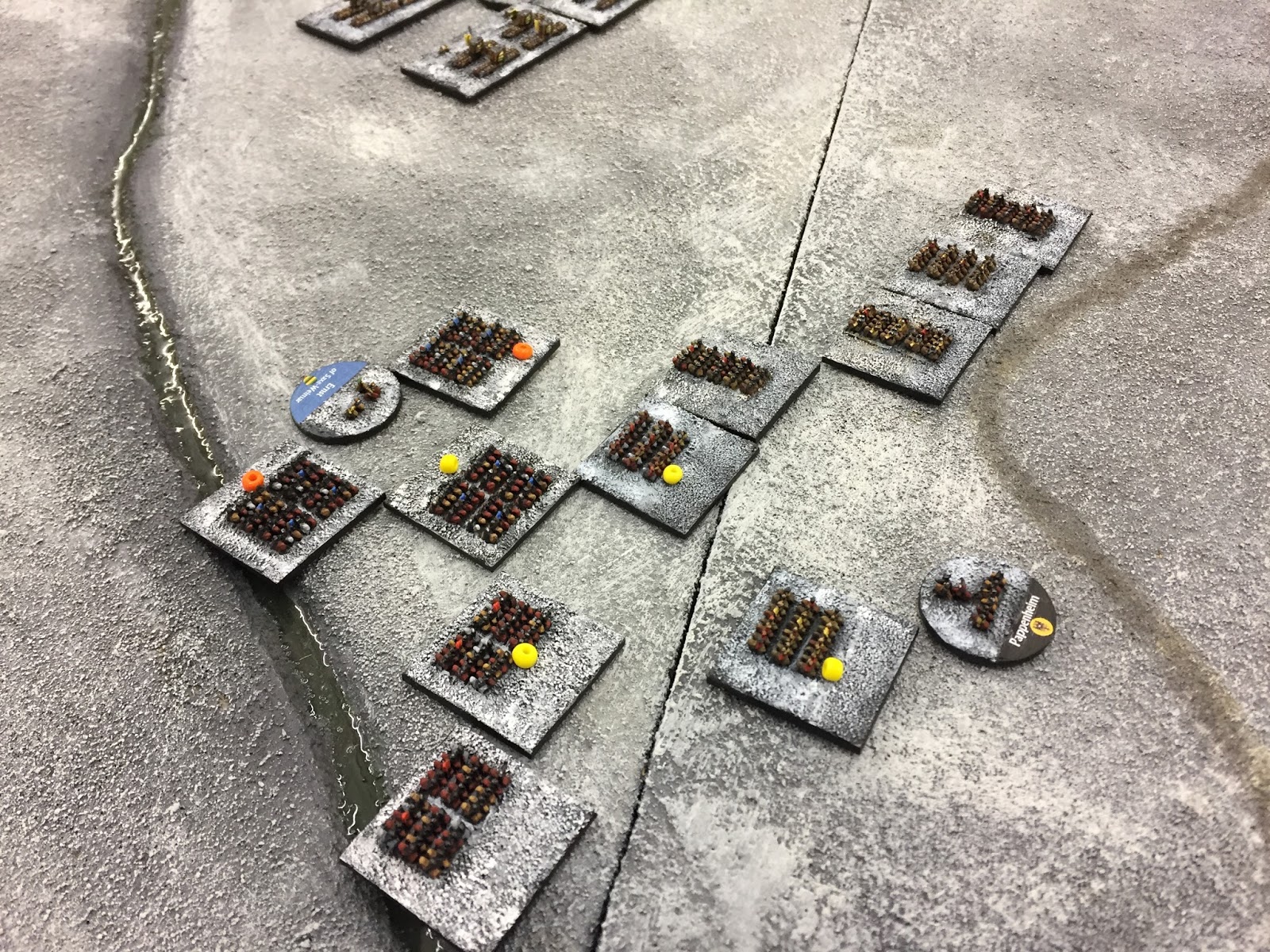
Ethos and aim: As you might recall, my intention (along with that of the game rules co-creator, Curt Campbell from the Analogue Hobbies Blog) has been to create a wargame focused on re-creating iconic 17th Century battles in a manageable space, and in a compressed time period (something around 2 to 3 hours wargaming time). I also want to try and capture the visual impression and “feel” of a 17th Century battle on the table top. As I mentioned in an earlier Blog post the visual aim is to try and recreate the “battle paintings” of Sebastian Vrancx and his pupil, Pieter Snayers, in which the battlefield is laid out before the viewer of the painting. Units are clearly seen, and their formations, but individual details are often sketched in. The impression is of the formations in the field, not of individual soldiers. I’m hopeful that the photographs below show that we are slowly getting towards a war-game which looks, even in a small way, similar to the fantastic pictures which Vrancx and Snayers painted.


Portability: A huge merit of the 2mm scale is that it’s portable. The whole game packs down into three boxes, which include terrain, and four terrain boards.  (More about making the terrain and the terrain boards is coming in a future Blog post). Set-up and pack-away time is reduced, making the scale perfect for a club-night or convention game.


Did you bring your spectacles? Yes, 2mm is a tiny scale to look at figures. But, if we’ve done our work correctly, it is the mass of troops in the army, and the battle formations, which are catching your eyes, and not the tiny individual soldiers. Of course, it is sometimes hard to resist the odd figures in a terrain diorama, like these Imperial courtiers watching the battle unfurl from the snow bound hills above Lützen. 


The Council of Warre: The game rules we have been working on start with the players on each side deciding the deployment of their respective armies in a Council of Warre. This involves allocating brigades to named commanders, and locations on the battlefield – the left and right wing, the main battle, the reserve (a key component of 17th Century large battles) and troops sent on "Discoverie" (the wonderful early 17th Century term for reconnaissance).

Decisions made in the Council of Warre will affect not only the way each army deploys on the table, but also the command and control exerted by the army commanders during the game. Last night’s players seemed to enjoy this planning phase, moving units in and out of Wings, Reserve and Discoverie for some time before coming up with what they felt was an optimal deployment for the battle. Hopefully, this is an echo of the Council of Warre which took place before many major battles of the period, with commanders jostling for resources and commands.


Keeping a reserve - One of the other key elements in the rules is the concept of a reserve – how large it is, the time in the battle when the reserve is deployed in the battle and the consequences of that deployment. We’ve tried to create a balance between wanting to use the units comprised in the reserve as soon as possible in the Field, and the morale benefits for the whole army in the reserve being held back until a decisive moment. 

This is hopefully achieved by inter-connecting the moment when the reserve is deployed with the subsequent impact of battle events on an army’s morale status. The earlier the reserve is deployed, the more troops a general will have to fight with - but greater the chance that casualties suffered following the reverse’s deployment will adversely affect the morale of the soldiers still fighting.  After all, once the reserve has been committed and they're taking casualties, what else is left....?


Cards: I like the idea of 'games within games'. It's a different dimension to the tabletop, and can create colour, theme, challenges and rewards in abundance.

Card management in fine games like Dux Brittaniarum, Maurice and Longstreet have really opened my eyes to the possibility of what might be achieved using activation and ability cards in an army level game. With this in mind, key actions in our Thirty Years War battle rules are permitted using Activation Cards – such as rallying units, reforming brigades, withdrawing shattered units, deploying reinforcements, re-supplying artillery. The cards interact with special abilities of the commanders on both sides. 

The cost to use a “ferocious charge” card for a cavalry commander such as Count Piccolomini (whose special ability of “Cavalier” reduces the cost for certain aggressive cavalry moves) would be less than the cost for an infantry commander to use the same card. It’s early days, but the players last night seemed to enjoy that aspect of the game even if I didn't do a great job of telling them what some of the cards were actually for!


Combat and formations – one of the aspects of the game which needs more work is the impact on formations of close fighting (such as push of pike or firefights at close range). Taken together, the infantry fighting last night did seem to ebb and flow like the real engagement, which had turned into a really tough infantry slog by the late November afternoon on the day of battle. 

Last night, we saw an Imperial Tercio trundling forward slowly, being difficult to manoeuvre, but relentless in its advance. We saw Swedish brigades deploying a marked advantage in firepower (at least the initial salvo). And we saw brigades being slowly worn down through “disorder”, being “shaken”, then “shattered” and finally “lost” (with coloured markers denoting each stage). So I think it's reasonable to think that we're heading along the right path. 

More difficult were the fiddly rules for things like interpenetration and push-backs. There’s much more work we need to do in looking at the books in this regard – both 17th Century works such as “Pallas Armata”, and modern commentaries like the books of Stuart Reid, Pavel Hrncirik and John Tincey.

Saturn is in quadrature to Mars in Scorpio – one of the things I tried to do before the game was to play a mini campaign by email, featuring just Dougie (Wallenstein) and Panda (Gustavus) as the commanders of both sides. The mini-campaign was a very simple “decision tree” campaign, introducing the big-picture strategic choices for both armies as they raced through southern Germany in the Autumn of 1632. 

I'm hoping to write it up in full and post the mini-campaign here on the Blog in the resources section for those interested. I like staging these mini-campaigns before a wargame.  True, they take a little extra work, but they certainly add some depth to what might otherwise be a one-off battle.  I tried to reflect the strategic choices of the two commanders during the mini-campaign in some tabletop top consequences.  For the Swedish forces, their focus on the mini-campaign on gathering allies was rewarded by a slightly increased number of Weimarian troops available to the Swedish allied commander, Duke Bernhard of Saxe-Weimar.  For the Imperial forces, their requests for a the recruitment of engineers was rewarded by the presence of Count Andrea Marmaladi on the tabletop (who you might just remember fondly from the "Warhammer Siege" rules), and the construction of a small redoubt in the middle of the Imperial line.


One of the elements I tried to build out in the mini-campaign was the role of astrology, superstition and the fascination with  the occult which seems to have been a feature of Wallenstein’s world outlook, as well as many at the Imperial Court in the early 17th Century. I think this was lots of fun, helped build the theme for the game - there’s definitely more to do in this regard as we refine the rules. I ended up making a set of cards just for Wallenstein, each one of which summarised a possible horoscope for the day of battle - Saturnine, Jealous, Rash (and so on) - each with a small impact on the tabletop.

The Thirty Years War was a conflict involving many remarkable, colourful, sometimes quite strange army commanders and noblemen. Somehow reflecting that in either the battle rules or the campaign setting is something I think people will enjoy.


I hope that’s enough of an insight for now. I’ve a few more 2mm posts to come this year, mainly relating to building 2mm terrain boards and Baggage Traynes. And also, in due course, there’ll be more from my 28mm Laarden project, including some book reviews and more figures. So, stay tuned!


Tuesday, 11 October 2016

The Sound of a Distant Drum: The Buildings of Laarden, 1688

One of the things I'm looking forward to doing in my late seventeenth century setting for wargaming is matching up my figures with terrain which looks like coming from the same period and place.  As many of you know, this can be a fairly lengthy progress.  Terrain gets built up slowly, with new pieces being added each year to the collection.

I've a vague, general plan to work on a set of Flemish terrain boards next year (probably in the Spring), but I'm still enjoying adding specific buildings and terrain features as I'm paint up figures during the course of this Autumn.

I'm particularly hoping to try and create a "feel" for the lost world of 1688 Flanders.  I've tried to do this by hunting down town plans from the period.  One of the nicest I've seen is the one in this  wonderful perspective map of Harderwijk from the 1670s:


I love the way that the buildings have a communal gardened area, frequently furnished with fruit trees.  I would imagine that within those enclosed areas, vegetables could be grown and poultry might well be kept.  And slightly outside the town buildings, perhaps an old, poorly maintained (and definitely not yet Vauban-improved) town wall, and an open landscape of dykes, poplars and windmills.

The first question is which buildings to use.  I've long been a great fan of the 25 mm buildings produced by Hovels in resin.  These are now pretty venerable, but have stood the test of time very well.  They are little small for modern sized 28mm figures, but fit the Dixon Miniatures and Foundry ranges for the 1680s and 1690s very well.  Although resin can be fragile, the "European" buildings range by Hovels in 25mm is pretty robust and fairly adaptable.  I'm planning to use the range for most of the Laarden buildings - they seem to catch the right feel and spirit of Flemish towns from the eighteenth and nineteenth century, and I am sure they will do fine for 1688 at a pinch.


The walled enclosures can be made using some of the 25mm walls available from Hovels.  These are a bit rough and ready, but nothing that some green stuff can't fill and fix.  I doubt that seventeenth century brickwork was universally perfect, especially brickwork used for enclosures and walled gardens.


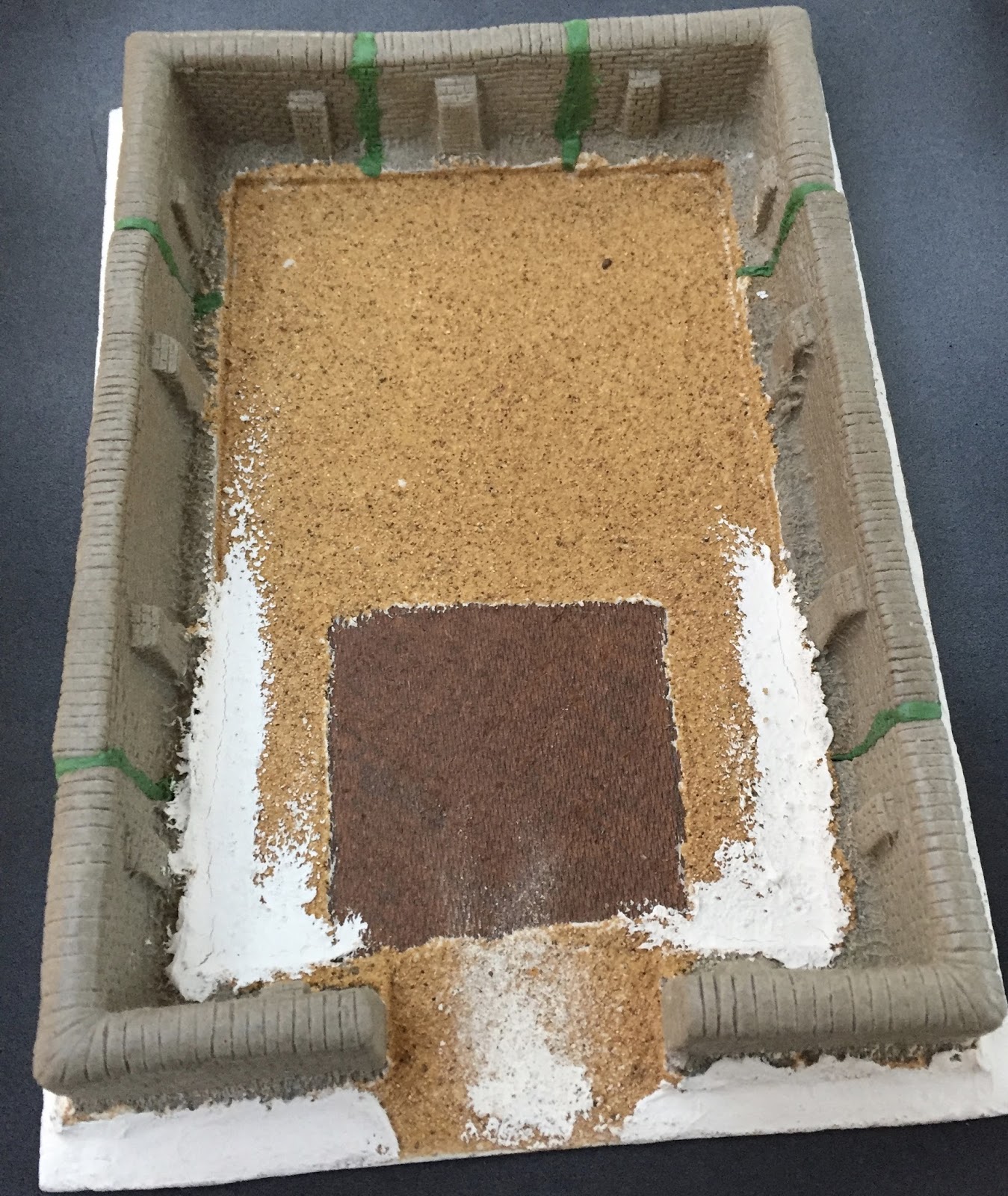
I've arranged this test terrain piece so that the building stands at the front of a walled enclosure, with plenty of room for a variety of terrain items to be slotted in the back.  More on those to come in a later post.


I'm planning some modest gate posts to finish off the front of the enclosure.  And of course, with every building, comes a variety of Laarden townsfolk.  More of that kind of nonsense to come in later posts.

Friday, 7 October 2016

The Sound of a Distant Drum: North German Foot, Legal Contracts and Oak-leaf brass fret


I’ve been steadily painting throughout September. I’ve finished three battalions of Flemish foot from Laarden (my fictitious town in the Spanish Netherlands of 1688), which are now in the process of being based. More of that in the next Blog post.

I’m moving on to a contingent of allied North German foot, recruited by the civic elders and burghers of Laarden to brace and supplement Laarden's otherwise creaking military capacity. Battalions of foot and horse could still be recruited through private contract and alliance in the late seventeenth century, and these formations have fascinated me for years. However, tracing the history of North German mercenary contingents is an obscure process. The Dutch States General were regular contractors for German and Brandenburg troops in the 1680s. On 5th August 1688, the Dutch States-General concluded a contract with the Elector of Brandenburg for 7,510 troops, a figure adjusted upwards to 7,884 in 1690. John Carswell’s excellent book "Descent on England: Study of the English Revolution of 1688 and its European Background" mentions that the contract, signed by the Duke of Portland, was one of many that summer with half a dozen princes across the North German plain. A treaty with Brunswick-Lüneberg-Celle was signed on 8 August 1688 to provide a further 2,710 soldiers. Agreements were also signed with Brunswick-Wolfenbüttel, Hesse-Cassel and the Duchy of Wurttemberg in August 1688.


These German mercenaries, hired by their own princes, dukes and electors, replaced Dutch troops which would either accompany William III on his invasion of England, or release Dutch troops to face Louis XIV in the Spanish Netherlands. 

I would love to be able to discover more regarding the actual contractual terms on which these contingents, battalions and squadrons were recruited. Did the contracts specify how long the troops would be hired for? Where would the troops be marshalled in anticipation of the commencement of the contractual term of hire? What conditions of use were stipulated? Was there any detail of any battlefield or campaign deployment mentioned in the contract (such as limitations on use in sieges, or in a geographical area "such troops not to be deployed south of the Sambre", and so on)? What provisions in the contract was made for death, wounding or desertion of troops, or loss of equipment?Did the troops bring any accompanying artillery? What did the contract state about looting, or what would happen if the formation was destroyed in action or on campaign?

Unfortunately, none of the books I have read cover these sort of details. It may be that this is yet another of those mysteries from the late seventeenth century which is probably under our noses, but well hidden.  Alternatively, it is perhaps more likely that the contracts for hire of such formations were fairly simple, just stating that a number of troops would be hired from a particular prince or elector by a certain time at a particular location. 

 But, as ever with wargaming, it’s fun to imagine the terms of contracts which might have been drafted by one of the Laarden civic dignitaries in a candlelight Flemish Voorhuis with the military plenipotentiaries from Emden, Lübeck, Leer or Bremen present in the room and looking on as the contracts of hire were negotiated. 

Here’s some (very draft) ideas which I’m thinking of building into a play-test set of battle rules for the period which I’ve been working on for the past few months:


Hired Battalion Contractual Conditions (roll 2D6)

2
“…the Hirer shall be at pains to ensure casualties are remain as low as can be achieved…”
The battalion will seek to withdraw two full moves distant from the enemy once disordered, and rally before being recommitted.

3,4
“… the Hirer agrees that he shall not wantonly expose the hired formations to close action …”
The battalion requires an extra command initiative point to be expended before engaging in close combat.

5.6
“… all battalions and squadrons to be marched in good order at all times…”
The hired formations require double command initiative point cost to be spent for first move made on the table.

7-10
“… such battalia to be used in the Field at the reasonable discretion of the Hirer…”
Troops to be used as desired.
11
“… the hiring of a battalion skilled in the art of the manoeuvres of the Great Gustavus …”
The hired formations may make complex manoeuvres at no additional command initiative point to complete.

12
“ … all formations to be well victuall’d at all times…”
The battalions are well supplied, with an additional baggage element added to the Trayne.


Turning to the North German troops I have in mind for my formations, I’m again using Dixon’s 25mm Grand Alliance range, mixed with a few Wargames Foundry figures to make up a forlorn hope (or “verloren kinderen”, if you prefer). 


To mark out the troops on the tabletop battlefield, I’ve been adding etched brass fret oak leaves to the soldiers’ hats. This is less fiddly than might appear. As long as you have a very sharp modelling knife of scalpel, the brass oak leaves can be cut out, bent and glued in place using tweezers pretty simply. I know that some figure manufacturers make these, but the etched brass fret are, I think, worth the extra trouble. 


You can pick up the etched brass oak leaves (and other leaves) from either Hasslefree or Scalelink. Both of these suppliers are great to deal with, and come recommended by me. The Hasslefree frets are very reasonably priced and are slightly thinner than the Scalelink ones.

Next time, it'll be a quick look at basing and more flags from Laarden.  Hope to catch you around for that!

Monday, 3 October 2016

Derby World Wargames - 1 October 2016


It’s been a while since I brought you a report from one of the wargames shows in the UK. There’s an obvious reason for this – which is I don’t get to visit many. Work and family life often prevent me from taking to the road and travelling around the country, even thought the shows are almost always on a weekend. It was a rare treat, therefore, to make the trip up to Derby World Wargames over the weekend (now held in Castle Donnington), accompanied by my good chum and Chief Lard-meister, Mr Richard Clarke.

We ran a participation game of ‘Viva Ras Begas’, and excellent short scenario using the Sharpe Practice 2 rules form TooFatLardies. The action was set in the Horn of Africa in 1840, and lots of details of the game, the figures and the terrain are available HERE on Richard’s Lard Island News website.


Everyone  seemed to have a fine time playing the game, which saw two thumping wins for the evil African slave-traders. Good job that history never turned out like this!  Huge thanks to everyone for playing, chatting or just stopping by.  


I had a good chance to walk around the show and collect a few things. I met new friends and old, and thanks to everyone who made me feel very welcome. I think that every one of the demonstration games I looked at was at least a very good standard, with a select few being really excellent. While not discounting the merits of the other games at the show, one game, based on the Battle of Rain in 1632, caught my eye.


As a Thirty Years War game it looked superb. I had the chance to chat with Dave, who was running the game and had painted the figures, at length. What I loved about Dave's game wasn’t just the amazing standard of painting of figures, or the superbly hand painted banners. What excited me was that the units had been built in a very eclectic manner, using figures from the widest possible range of 25mm figure manufacturers. 


There were Wargames Foundry, Warlord Games, Essex, 1st Corps, Dixons, TAG, a small number of Redoubt and no doubt others in the Imperial, Weimarian and Swedish regiments and squadrons. While figures of markedly different sizes were not mixed in the same unit, Dave mentioned that he had gone out of the way to mix figures of the same size of different manufacturers. The result was amazing. The differences in 25mm figure size and style blended seamlessly, as they so often do when the figures are on finished bases on fine terrain. Sometimes when we hold two 25mm figures in our hand, they can look to be very differently sculpted, shaped, sized and proportions. When painted, these differences can, I think, melt away in the glory of a game like Dave’s.


The one downside of an otherwise good venue was the dodgy lighting, as sadly you can see from some of the photos above. For once, my hamfisted photography was not to blame, but rather it was the electric light in the venue, which seemed to have a distinct ivory cream glow to it. If the colours in the photos look a little vivid, and on the yellow-ish side of the colour wheel, I am sorry – but for once, I don’t think it’s my fault!
Related Posts Plugin for WordPress, Blogger...