
After all the planning, blogging, frantic activity and late night terrain making, I finally got to Operation Market Larden on Saturday in Evesham. I ran two games of Operation Gericht on the day, making that four games in June, and six of the game overall including the playtests in May.
Before I move on to the game itself, allow me to say some thank you to some heroic endeavours. To Ade, Paul and the rest of the Wyvern Wargamers, thank you for arranging such a great day’s gaming.

To the players who participated in the game (Paul and Dane, Paul (Pingu) and Dave, Bob and Phil, and Paul and Ralph), thank you all so very much for taking part. Eight finer players for the game I could never have imagined.
.jpg)
Thank you all for making it such a pleasure to umpire for you – you can all come again, anytime! And huge thanks to everyone who made the trip to Evesham for the day, and for the great curry afterwards. The day of wargaming with friends by far made up for the disappointing footie result!

With thanks to Phil and Paul and many others who stepped into the breach when my iPhone’s battery died at 11am, I’ve posted below some pictures from the games. Both of the games were finely balanced right up to the end. I’ll post the full player briefings later this week, along with the additional rules and rule adaptations for the game which (hopefully) bring out some of the unique challenges of wargaming Verdun.

In the first game, Dane and Paul as the German Stosstrupp slaughtered the French defenders of the Bois de Chapitre in a massive close assault, but then found it hard going through the wood itself. The French defenders, Pingu and Dave, carefully nurtured their forces in Fleury itself, making it near impossible for the German attackers to obtain even a small fingerhold in the village. The result was a notable German success, although falling short of a German triumph.


In the second game, the German forces of Bob and Phil opted for a bold plan. Unlike all of the German forces in the three previous games played (and the two playtests), they decided to surge around the Bois de Chapitre and attack the village of Fleury outright. In doing so, they opted to try for an all-out victory, denying themselves the possibility of a notable success by taking the Bois de Chapitre. It was a bold plan, made workable by a very imaginative artillery fire-plan. Instead of barraging the entire width of the table with the German supporting barrage, the German players opted to barrage in two stages: the first on the Bois de Chapitre only, the second on the base line of French defences in Fleury itself. The overall plan was certainly bold, perhaps even slightly reckless. However, the German players appreciated they had good German troops and they carried their plan out with great determination in the face of very skilled French opposition from Paul and Ralph.


For 90 minutes, I thought Bob and Phil had made a mistake. They seemed to be bogged down in No Man’s Land, their formations suffering dislocation from French fire. However, their main artillery barrage, timed for the seventh turn, came in at precisely the time when French defenders at Fleury were redeploying to fire on the German forces. The French suffered two turns of artillery barrage in which they could do nothing but take cover in their defences.

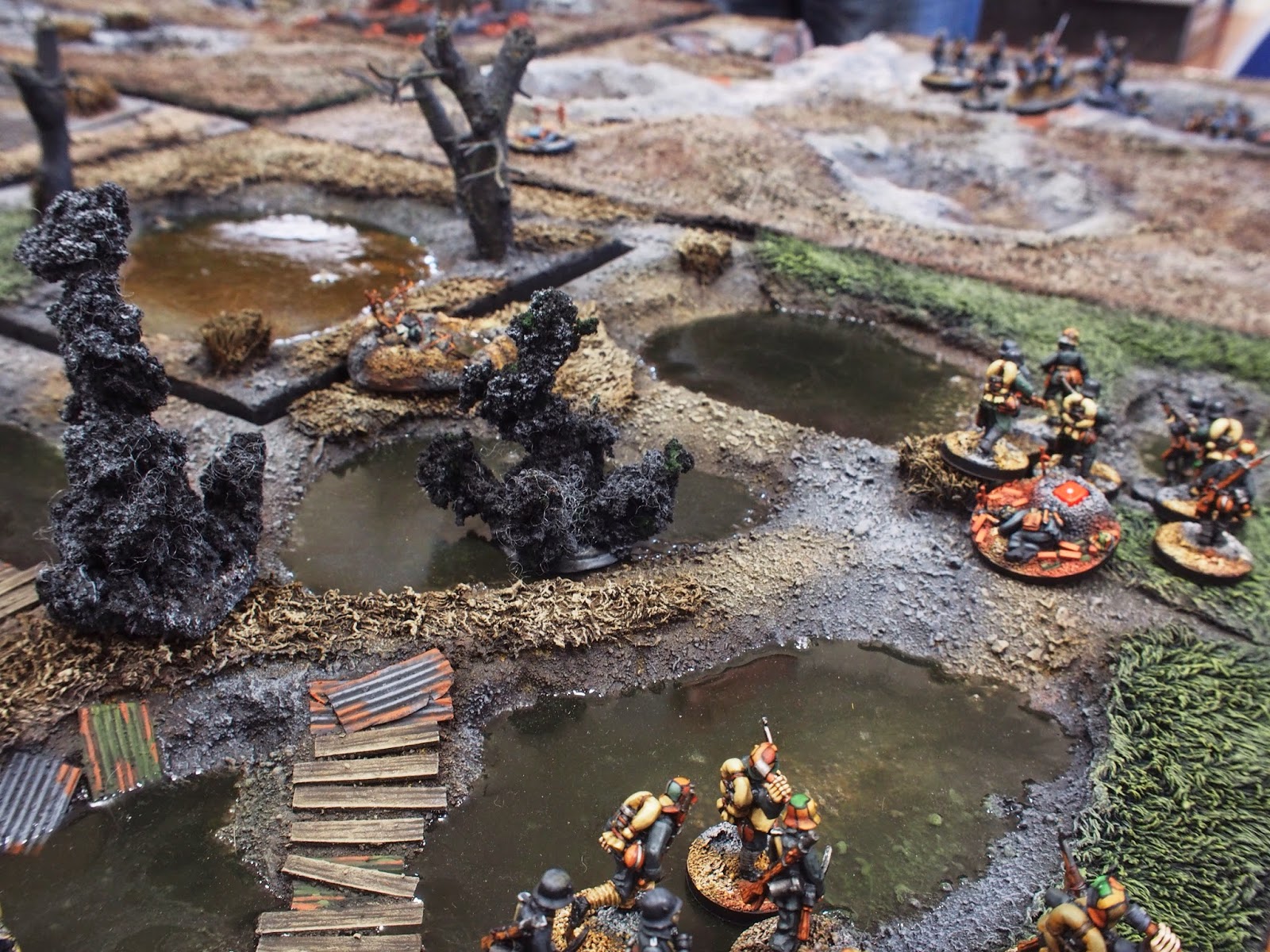
This gave the German Stosstrupp just enough time – and I really do mean just enough time – to rush forward and contact the French defenders in Fleury itself. In the last turn of the game, the Germans won the close combat for the Cordwainer’s House, bolstered by choosing an “inspiring speech” from their commander as a pre-game option. The French fell back, and the Germans took the French strongpoint on the edge of Fleury for the first time in six games.


In short, it was a German triumph, and very pleasing to watch unfurl. The French defenders were magnificent (and very magnanimous) in their game-play, but ultimately had no answer to a perfectly planned German assault driven home by an inspiring German tabletop commander.

So, the Knight’s Cross gets awarded to Hauptmann Ulrich von Bek (who we found from the “Big Man German Exits” remained in the Heer after the end of the Great War, suffering the slight indignity of going on manoeuvres on bicycles while awaiting the whirlwind of the 1930s), and no doubt a consolatory cognac for the French defenders as they fell back to their main line defences around Fort Souville.
I thought it might also be useful, after four participation and two play test games, to set out what I feel I’ve learned from the games.
- Trying to recreate Verdun on the wargames table in a historical manner at a small is very difficult. The strength of the artillery and off-table machine guns, firing on fixed lines, makes assaults murderous. Attacks will fail if not well supported. Attacks will also flounder in bad terrain.
- The French, as the defenders in the early part of the battle, face a herculean task to hang on. Staging these games has made me respect to an even greater degree the titanic sacrifices of the French army and French nation in just holding on at Verdun.
- On the tabletop, fighting “down the table”, as opposed to “across the table” is a big challenge in a 2 – 3 hour game. It looks better, and plays more sensibly, but the attackers need to have markedly stronger forces, and some compensation for the distances they need to travel and fight. (I added in an extra, second, Sturmabteilung Vor! card into the deck for the German forces in Evesham to compensate for the Bois de Chapitre, but not at Partizan. I should have done the same at Partisan.)
- Single mounted figures take too much time to move. I’ve since ordered some figure movement trays from Martin at Warbases to speed the movement phase up.
- Operation Gericht was a large game, and the card deck was considerable. It contained seven Big Men for each side, plus three additional support weapons cards. I thought this was right on the edge of what was workable. I’ll slightly reduce the size of the game for the next participation.
- Players seemed to like the background I had created on-line. I didn’t have as long as I wanted to get this up and running. A month, and a slower burn, would have been better.
- Organising artillery fire-plans in “Through the Mud and the Blood” is a lot of fun, but does take some time and planning. We ran a bit short of tabletop gaming time with the second game because we spent longer in the artillery planning phase. That being said, I thought the introduction of the fire-plan and artillery barrage improved the games immeasurably, and was (at least for me) critical to trying to create an atmosphere of the battle we were trying to recreate. Both the French and the German players used their fire-planning as a significant and valuable tool, and this really added to the game. Watching the French defenders’ faces as the “French SOS Artillery” card finally arrived in the second game was a real treat.

As mentioned above, I’ll post the player briefings over the next week or so. Until then, it’s a short hiatus in the Verdun/ French project while I gather breath. Then, in July, I’ll look a little further towards the Nivelle Offensives of 1917 and the first deployment of the Artillerie Spéciale. Hope you can join me for that!


.jpeg)


