Showing posts with label Thirty Years War. Show all posts

Saturday, 10 October 2020

"Slow, uneasie and troublesome": Tales from the Baggage Trayne

"The great number of Coaches, Waggons, Carts, and Horses loaded with baggage, the needless numbers of Women and Boys who follow Armies, renders a march, slow, uneasie and troublesome." 

Sir James Turner, Pallas Armata, 1670.

Dear Readers, you might remember Sir James Turner, and his magisterial book, "Pallas Armata: Military essayes of the ancient Grecian, Roman, and modern art of war" from other posts here on the Blog. Sir James is the gentleman, experienced in the savage fighting of the Thirty Years War, who failed to write about precisely what happens in the heat of battle, but was capable of writing pages and pages and pages about the minutiae of seventeenth century warfare. 

Sir James spends three of four pages of "Pallas Armata" devoted to baggage "traynes", "waggons" and provisioning. According to Sir James' account, the number of "waggons", carts and horses accompanying an army in the field could be extremely high. He provides an entertaining scale of different wagon numbers for different armies in the Thirty Years War - Swedish, French, German and Danish - noting that 900 wagons for 6,000 horse and foot was not unusual.

With this in mind, I thought I'd have a go at creating some suitable baggage for a seventeenth century trayne.  


I had bought one of "Colonel Bill's" larger wagons, with a Renaissance artillery load, from the Colours show last year.  It was a joy to make, fitted perfectly, and painted up easily..  The heavy horses were a little rough-coated, but I quite liked that - being different in look to the sleeker horses of the Horse and Gendarmerie.  You get a jumble of bits in the MDF pack, but it comes with some useful instructions.


I added a couple of additional russet-coated musketeers, trudging along with the wagon, and a Wargames Foundry wagoneer, alongside the Colonel Bill's horse-ostler.  A Warbases 3mm MDF base completed the wagon, ready to join (or start off) the baggage trayne.


Listeners to the TooFatLardies "Oddcast" might remember that one of the books I mentioned in the Library section a year back was "The Memoirs of James II".  As I mentioned on the "Oddcast", James, Duke of York, was obsessed with .... fodder.  Barely a page goes by in the Duke's book without mentioning provisions, baggage, lines of march, fodder, forage, horse-feeding and logistics.  It's an amazing read, although one I found I needed to read through with a map or Northern France and Flanders by my desk most of the time.  

I wanted to create some wagons in the baggage trayne bringing fodder for an army's horses.  One of them I bought from "Blotz" at the Salute show a few years back.  The other I scratch-built from bits and pieces on my work-desk - card, some spare wheels and a couple of Wargames Foundry villagers.


The hay-fodder was made from a chunk of blue styrofoam, which was covered with a mix of cut up floor mat, sissal-string and small garden twigs. Dry-brushed with some matt emulsion from Dulux called "straw" (no, I'm not joking), I thought they looked the part. I added some loose chains, dry-brushed with Vallejo gunmetal, to complete the models.

And now, all I need is some rampaging dragoons or Croatian "hussars" to attempt to sack the baggage trayne ... while any defending horsemen make "handsome Sallies".  Here's Sir James, again - 


"When Convoys are put to fight for defence of their Charge, as many times they are, (for the desire of booty spurs men to desperate attempts) they should (if conveniently they can) cast themselves within the Waggons and Carts drawn up round for that purpose, from whence Musqueteers may do notable service, and out of which retrenchment the Horse may, as they see occasion, make handsome Sallies."

*******

Friday, 4 September 2020

In The Cold Season of the Year : A miniature campaign version of Laarden, 1688


One of the things I've been doing in Lockdown is working through a list of projects I've wanted to finish for some time.  This has included creating a very miniature version, of the old Games Workshop "Mighty Empires", set in the cold, winter-bound countryside of 17th Century Flanders.

I've always been fascinated by games which reduce military campaigning to a manageable, miniature scale.  Reading the accounts of soldiers through history, campaigning seems to have been anything but manageable, and 17th Century campaigning was no exception.  Yet there is something which really appeals to a world-building wargamer in trying to reduce a messy, chaotic, sprawling experience - moving armies across a potential battlefield - into a coherent, neatly manageable, tabletop experience.


“Mighty Empires” had the same feel about it, although the scope of that game was far greater – it created both a campaigning and battle game, as opposed to just a wargames campaigning tool.  I wanted to take my inspiration from the look and framework of “Mighty Empires”, but leave the project as a campaign tool only – being an attractive way of setting the scene before the action moves to the wargaming tabletop.

Projects often take some time to come to fruition, and this was no exception.  I’d had the 40mm hexagon tiles, in 3mm MDF, from Warbases, for some time.  I was also left with a fairly large amount of 2mm terrain pieces from Irregular Miniatures, a surplus from my Thirty Years War project in 2mm a few years back.  My first decision was whether to continue the winter-terrain theme from the 2mm Thirty Years War collection, or create something for summer or autumn to match my 28mm Laarden figures.  In the end, I went for the former, really because I thought winter campaigning offered some interesting challenges as a game environment.


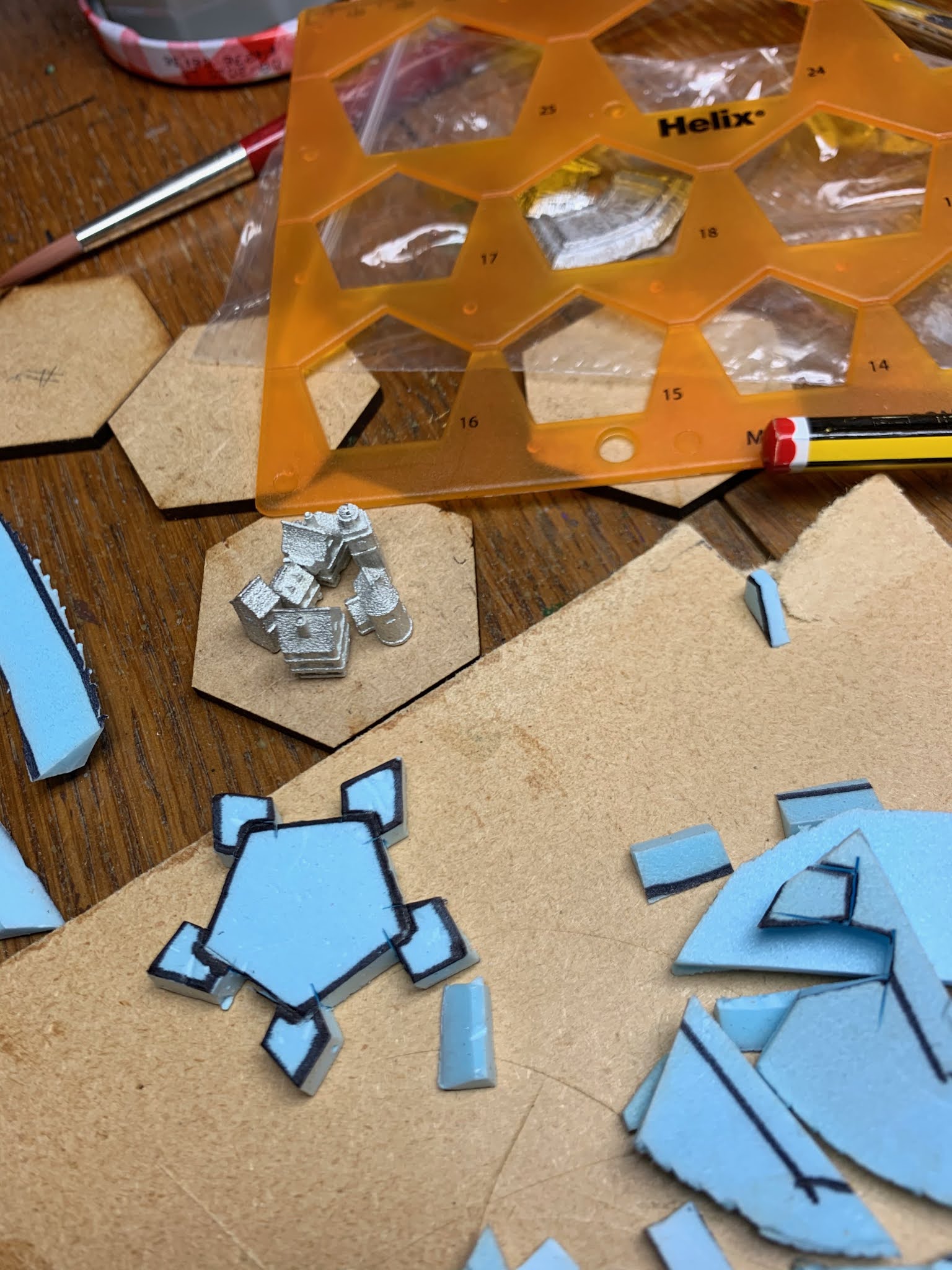
Creating the small terrain tiles was quite fun, and not too difficult.  I had thirty hexagon tiles, and I wanted a variety of terrain types, mainly reflecting northern France and Flanders.  Woods, low hills, windmills, a river, some bad roads, several small villages and a small walled town all seemed to fit with the theme I wanted.  Much of this was scratchbuilt – with hills being scraps of extruded Styrofoam covered with Polyfilla, woods being clump foliage and the river banks being built up with green-stuff putty.  The Irregular terrain items made good-looking villages and farms.  The town was carved and cut out with a very sharp scalpel, using a stencil, and with Brigade Models’ 2mm buildings adding the ‘look’ of a Flemish town of late-17th Century.


As you can see, most of the items were basically scrap or left-over items from other projects.  I always like to try and get some use from leftovers like this, rather than consigning them into a spares-box for a decade or so!

What I was trying to create was something which looked like a reasonable approximation of a campaign map – showing major features, albeit major features which were somewhat out-of-scale and exaggerated.  I wasn’t keen on creating anything like a properly scaled model of a late-17th Century fortified town for the project.  Rather, I wanted to create something which had the feel of such a place.

I painted the hex tiles with a light grey emulsion paint, with a dry brush of white emulsion.  The woods I soaked in PVA, and then painted them black, and dry brushed brown, then light grey.  The cold, slow-running river was painted in a dark blue, with a couple of coats of varnish.  And some “1mm snow”, essentially cotton dust, finished the look I was aiming for.

Hopefully this will be a portable, and very versatile, campaigning tool, adaptable not just for the 17th Century, but for just about anything from 1550 to 1815.  Maybe it can even fit an earlier period if I add a medieval-walled town instead of the trace italienne version.  The tiles should be versatile enough to be picked out by the players at the start of a club night game, or selected before a tabletop battle and turned into a suitable paper map through a few photographs and maybe a little photo-shopping.

I’ll have a look in the next blog post at some possible rules to use with the tiles, again with a grateful nod in the direction of “Mighty Empires”.  

Also, while on the subject of acknowledgements, I’d like to thank fellow-Twitter user, Adam Clark, for his own posts of his “Mighty Empire” tiles from a recent Kickstarter, which were very inspirational and prompted me to rescue this project from the ‘pending’ pile.  Thanks Adam!


Monday, 15 January 2018

Thirty Years War in 2mm: Nördlingen 1634


Following on from my last post, focusing on a regiment of Flemish Horse in 25mm, I thought I’d post some pictures of their 2mm counterparts. Yes, ladies and gentlemen, it’s “spectacles on” time again here at Roundwood Towers as we delve again into the oddly compelling world of 2mm micro-miniatures.


For new followers to this Blog, it might help to let you know that in 2016 I started a project trying to replicate on the tabletop key battles of the Thirty Years War (1618-1648). Rather than collecting an army in a larger scale (such as 28mm or 15mm), I went for the smallest generally used wargames scale – being 2mm.

This is not quite as insane as it sounds (and, yes dear readers, I am aware of just how insane it does sound). Key elements of the thinking behind choosing the 2mm scale were to create a wargame focused on re-creating iconic 17th Century battles in a manageable space, and in a compressed time period (so you could easily play a game in an evening). The 2mm scale enables whole armies to be recreated quickly, with one unit base equating to a whole formation (battalion, regiment, tercio or brigade of foot; squadron or regiment of horse; battery of artillery; and so on). The scale of the units then hopefully allows the chance to test out multiple Spanish tercios against Swedish brigades, allows to add commanded musketeers into the line, and lets the players deploy multiple lines of infantry and horse on each side (as at Lützen, Rocroi and many other battles). Hopefully, the recreation of the battle then focuses on tactical contrasts, and far less on individual unit formations.


I set out more of the thought process behind the scale choice in a couple of earlier posts on this Blog (HERE and HERE). Suffice to say its now 2018, and I’m still very much enamored of the potential afforded by 2mm, in addition to being captivated by the possibilities of modelling their micro-world.


After collecting armies for the battle of Lützen in 1632, the next additions are based around the Spanish army of the Cardinal-Infante which made the long march through Italy and Germany to be present at the battle of Nördlingen in 1634. Here I've painted some German horse, Spanish demi-lancers, a party of Croat scouts or vedettes, some Spanish commanded shot and (to balance things out) some Swedish and Finnish scouting horse. The command bases are the Cardinal-Infante, and the Count of Fuensaldaña, one of the Spanish-Imperial commanders of the later Thirty Years War.


The figure bases are colour coded for ease of recognition on a snowy tabletop - blue for Swedes, Black for Germans and deep (Hapsburg) red for the Spanish. This works really well in practice, and helps with a section in the rules we’re writing relating to allied contingents. One of the things which conceals the nationality of the troops from an opponent on the table is to ensure that the colour coding is limited to the rear of the figure bases. 

I've experimented with some 1mm snow 'flock', which is quite fun. It's really like a fine dusting of miniature cotton, but makes quite convincing show, which would be decent 'slush' in a larger scale. I added the labels for the commanders from a printed PowerPoint file, trimmed and glued on with PVA.


I thought the 1mm snow definitely added something, but was fiddly to apply.  An optional extra, but far from essential. 

I've also started painting up some larger terrain items, including this small town which I've tried to render in a Flemish or North German brick effect.  The town was very kindly sent to me by wargaming chum, and very good friend, Matt Moran.  Thanks again Matt for your great generosity!


I've really enjoyed making terrain in 2mm (not least because its so easy to finish whole towns in an evening).  The 'world-building' aspect of this scale is just as addictive as in larger scales. 

Next up will be some more larger scale terrain and figures from Laarden, 1688, along with a couple of book reviews.  Have a great start to the week, everyone!

Monday, 13 November 2017

Thirty Years War in 2mm - An Update for Patient Readers


For anyone reading this Blog who has been patiently waiting since last year for an update on our 2mm scale Thirty Years War project, I have some good news (and an apology). 

As you might recall, last year I built a collection of 2mm scale armies to re-fight the battle of Lutzen in 1632. Full details of the ideas behind the project can be found on a couple of earlier Blog posts, HERE and HERE.


It’s probably helpful to mention that, during the last year, the thematic ideas which Curt (fellow rules author) and myself started with have not changed a great deal. We are still looking for our rules for the period to create a wargame focused on re-creating iconic 17th Century battles in a manageable space, and in a compressed time period (so you could easily play a game in an evening).

We're still focusing our efforts on the Thirty Years War, which provides a wealth of significant, reasonably well-documented battles to attempt to recreate.  It's also a fortunate co-incidence that next year will be the 400th anniversary of the commencement of the war, which might prompt an interest in looking at different ways of wargaming the conflict.

And we are still looking to try and recreate the unique visual elements of large scale “battle paintings”, and focus on the attributes of battle and warfare which contemporary commanders considered - in their diaries, letters, orders and commentaries – were important in determining victory in the field.

What has been evolving have been the rules themselves as we tinker with mechanisms, talk through variations, play-test scenarios and parts of the battle, read more (and more) and generally try and refine and finesse what we have on the printed rules pages.


As anyone who has written, or adapted wargame rules, this is quite a difficult process. Just when you think progress is being made in one area, something else slips out of place, perhaps as a consequence. The challenge for me has been to try and retain the themes which I consider make the warfare of the mid-Thirty Years War unique, while also making the game playable and fun. Some of the most difficult elements of rules writing and play-testing have involved the combat mechanisms at the heart of the battle.

Part of the challenge has been to both understand what happened in mid-seventeenth century battles and, in particular, how contemporaries believed those events affected the course of the fighting.

As Sir James Turner wrote in his commentary on the arts of warfare, “Pallas Armata”:


*****
Of all Martial Arts, to fight a Battel well, and gain the Victory, is of the highest importance, and makes the Prince or his General most renown’d: It is this (and neither retreats nor taking Towns, though both these shew the qualifications of an excellent Captain) that crowns them with Laurels.”
*****


This is all wonderful, stirring stuff. And there are endless exhortations of this type throughout "Pallas Armata". What Sir James’ commentary is rather short of is what actually happened at the sharp end of a melee or a firefight. Here’s the commentary in a key chapter of “Pallas Armata”, Chapter XXII (“Of things previous to a Battel, of a Battel itself, and of things after a Battel”) on melees:


*****
Your advance on an Enemy, in what posture soever he be, should be with a constant, firm and steady pace; the Musketeers (whether they be on the Flanks, or interlin’d with either the Horse or the Pikes) firing all the while; but when you come within Pistol-shot, you should double your pace, till your Pikes closely serr’d together, charge these, whether Horse or Foot, whom they find before them. It is true, the business very oft comes not to push of Pike, but it hath and may come oft to it, and then Pike-men are very serviceable.  (Spelling all as in the 1671 edition)
*****


There is an immediacy and great vitality through the whole of “Pallas Armata”. It’s evident Sir James Turner knew precisely what he was writing about. But to me, reading in 2017, the precision, granularity, and detail of the fighting you’re looking for as a (very) amateur rules-designer is absent in the text. And, in my view, the same is true of other commentators (Montecuccoli, the Earl of Orrery, Richard Elton) who were writing around the same time.


So, we’re working through the rules mechanics, and carrying on play-testing, and continuing to try and make sense of what happened in the battlefields of 1632 and 1634 - as well as re-reading Sir James Turner's writing and wondering what on earth he meant! 

When Curt was over last week, we played through a pared down game of the battle. This featured a couple of memorable events, principally the shattering of part of Count von Pappenheim’s impetuous cuirassiers by means of a well-deployed, enfilading Swedish artillery battery. And yes, that is one of the 2mm “shattered bases” being deployed into the ragged Imperial mounted line…


Also featuring in the game were some lovely scratch-built 2mm snow-bound villages made by good friend, Mark Backhouse.  And also, somewhat bitten by the 2mm scratch-building bug, it was the first game in which I fielded the Imperial Chancellery baggage trayne which I made a couple of months back but have only just got around to painting.


Although the rules are written, and fairly comprehensive, we’ve a fair way to go in play-testing a set of rules which I hope will be both accurate and fun. And fear not, you’ll be the first to know when that happens!


Related Posts Plugin for WordPress, Blogger...