Showing posts with label Rule Mechanics. Show all posts

Monday, 13 November 2017

Thirty Years War in 2mm - An Update for Patient Readers


For anyone reading this Blog who has been patiently waiting since last year for an update on our 2mm scale Thirty Years War project, I have some good news (and an apology). 

As you might recall, last year I built a collection of 2mm scale armies to re-fight the battle of Lutzen in 1632. Full details of the ideas behind the project can be found on a couple of earlier Blog posts, HERE and HERE.


It’s probably helpful to mention that, during the last year, the thematic ideas which Curt (fellow rules author) and myself started with have not changed a great deal. We are still looking for our rules for the period to create a wargame focused on re-creating iconic 17th Century battles in a manageable space, and in a compressed time period (so you could easily play a game in an evening).

We're still focusing our efforts on the Thirty Years War, which provides a wealth of significant, reasonably well-documented battles to attempt to recreate.  It's also a fortunate co-incidence that next year will be the 400th anniversary of the commencement of the war, which might prompt an interest in looking at different ways of wargaming the conflict.

And we are still looking to try and recreate the unique visual elements of large scale “battle paintings”, and focus on the attributes of battle and warfare which contemporary commanders considered - in their diaries, letters, orders and commentaries – were important in determining victory in the field.

What has been evolving have been the rules themselves as we tinker with mechanisms, talk through variations, play-test scenarios and parts of the battle, read more (and more) and generally try and refine and finesse what we have on the printed rules pages.


As anyone who has written, or adapted wargame rules, this is quite a difficult process. Just when you think progress is being made in one area, something else slips out of place, perhaps as a consequence. The challenge for me has been to try and retain the themes which I consider make the warfare of the mid-Thirty Years War unique, while also making the game playable and fun. Some of the most difficult elements of rules writing and play-testing have involved the combat mechanisms at the heart of the battle.

Part of the challenge has been to both understand what happened in mid-seventeenth century battles and, in particular, how contemporaries believed those events affected the course of the fighting.

As Sir James Turner wrote in his commentary on the arts of warfare, “Pallas Armata”:


*****
Of all Martial Arts, to fight a Battel well, and gain the Victory, is of the highest importance, and makes the Prince or his General most renown’d: It is this (and neither retreats nor taking Towns, though both these shew the qualifications of an excellent Captain) that crowns them with Laurels.”
*****


This is all wonderful, stirring stuff. And there are endless exhortations of this type throughout "Pallas Armata". What Sir James’ commentary is rather short of is what actually happened at the sharp end of a melee or a firefight. Here’s the commentary in a key chapter of “Pallas Armata”, Chapter XXII (“Of things previous to a Battel, of a Battel itself, and of things after a Battel”) on melees:


*****
Your advance on an Enemy, in what posture soever he be, should be with a constant, firm and steady pace; the Musketeers (whether they be on the Flanks, or interlin’d with either the Horse or the Pikes) firing all the while; but when you come within Pistol-shot, you should double your pace, till your Pikes closely serr’d together, charge these, whether Horse or Foot, whom they find before them. It is true, the business very oft comes not to push of Pike, but it hath and may come oft to it, and then Pike-men are very serviceable.  (Spelling all as in the 1671 edition)
*****


There is an immediacy and great vitality through the whole of “Pallas Armata”. It’s evident Sir James Turner knew precisely what he was writing about. But to me, reading in 2017, the precision, granularity, and detail of the fighting you’re looking for as a (very) amateur rules-designer is absent in the text. And, in my view, the same is true of other commentators (Montecuccoli, the Earl of Orrery, Richard Elton) who were writing around the same time.


So, we’re working through the rules mechanics, and carrying on play-testing, and continuing to try and make sense of what happened in the battlefields of 1632 and 1634 - as well as re-reading Sir James Turner's writing and wondering what on earth he meant! 

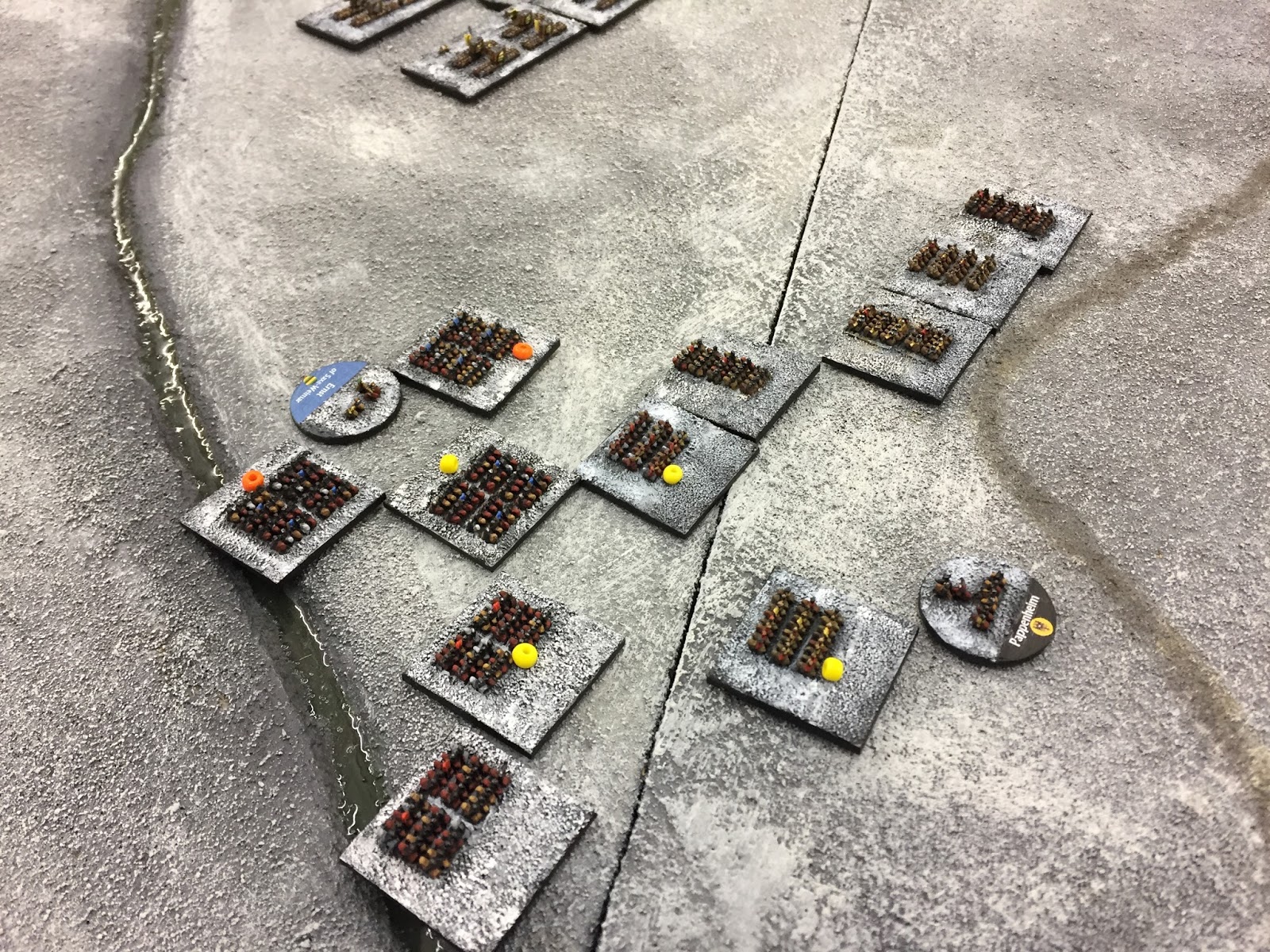
When Curt was over last week, we played through a pared down game of the battle. This featured a couple of memorable events, principally the shattering of part of Count von Pappenheim’s impetuous cuirassiers by means of a well-deployed, enfilading Swedish artillery battery. And yes, that is one of the 2mm “shattered bases” being deployed into the ragged Imperial mounted line…


Also featuring in the game were some lovely scratch-built 2mm snow-bound villages made by good friend, Mark Backhouse.  And also, somewhat bitten by the 2mm scratch-building bug, it was the first game in which I fielded the Imperial Chancellery baggage trayne which I made a couple of months back but have only just got around to painting.


Although the rules are written, and fairly comprehensive, we’ve a fair way to go in play-testing a set of rules which I hope will be both accurate and fun. And fear not, you’ll be the first to know when that happens!


Friday, 27 January 2017

"The Pikeman's Lament" - Pike & Shot skirmishing from Osprey Games


One of the great things about the wargaming hobby is seeing friends and fellow wargamers enjoying fantastic success doing the very things which make our hobby such fun.  For many years I've been enjoying the excellent "Dalauppror" blog authored by Michael Leck, who I had the great pleasure and privilege of meeting at Salute a few years back.


Michael's rules for pike and shot wargaming, "The Pikeman's Lament", written with well-known wargames rules supremo Dan Mersey, were published yesterday by Osprey Games.  I'd pre-ordered my copy, and they were waiting for me when I arrived home last night.

They are a lovely looking set of rules, and feature everything that you would need for recreating small scale engagements and large skirmishes in the 17th Century.  There are many fine illustrations from the Osprey books, and some terrific photographs from many well-known wargamers and modellers, including Michael himself, the super-talented Matt Slade and all-round blogging superstar Mr. Michael Awdry, who posted some great photos on his own blog HERE which didn't quite make it into the finished rules owing to space constraints.


I'me really looking forward to giving these rules a try.  The "petite guerre" of raiding, forcing contributions, scouting and skirmishing was a major feature of many seventeenth century campaigns, particularly during the winter months when main field armies were in winter quarters.  


Michael and Dan's rules should be perfect for recreating these kinds of actions - swirling cavalry skirmishes, desperate last stands of small companies of soldiers in remote villages, plundering of supply columns.  These types of encounters were a very popular theme in mid-seventeenth century 'battle-paintings' - and there's plenty of inspiration to be gained from searching out paintings such as the above canvases from the Dutch artist Pieter Meulener.

I really looking forward to using the rules for my own chosen period of the 1680s in Flanders - a brief read through of the rules last night gave me some (hopefully) good ideas for the games we can stage and the terrain I can build for these kinds of actions.

Here's hoping these rules spark everyone else's imagination.  Congratulations to Michael and Dan, and best of luck with the venture!!

Saturday, 31 December 2016

Roundwood Recommends - number 7: "War and Rural Life in the Early Modern Low Countries": Myron P. Gutmann (Princeton University Press), 1980


Then, when it appeared they were going to put siege to Maastricht, they camped, some at Montenaken, others at Laneken, and a large part of the army here at Emael. The Marques of Salada lodged here with three regiments, one of foot, and two of cavalry. They behaved worse than barbarously: they destroyed everything: they cut trees, completely demolished many houses, and trampled whatever grain they did not steal, not even leaving enough for the hunger of the poor farmers” (Priest at Emael, 1632)

I’ve always been envious of roleplaying supplements which describe in loving detail the background, political and economic environment, demographic features, weather and geographical context of the world in which the player characters’ undertake their adventures. Everything is to hand, and the characters exist in a world which really lives and breathes. Information which people in that world would immediately know can be looked up, or simply made up. 

Real life history isn’t like that, at least not in the more obscure periods of history which wargamers sometimes like to visit. Those kinds of details which might be obvious to historical contemporaries can be difficult to track down, scattered over dozens of books. Which are the main population centres, and did they serve as viable winter quarters for assembling armies? Why was a particular town so attractive to armies looking to establish an encampment? Which was the lowest point on the river which was bridged in 1688? Where were the rural areas in which armies were marshalled, and how did this correspond with good foraging opportunities? Answering such questions can add a lot of context to our understanding of how any military campaign developed. 

These are questions which would be obvious to a 17th Century general, but often are lost to us. Reconstructing that lost world takes time. Once you stray off the beaten English-language path, and into the dustier periods of history, you find that sooner or later you’re forced to rely on academic studies, the primary focus of which is not military history, let alone wargaming.


War and Rural Life in the Early Modern Low Countries” by Myron P. Gutmann is one of those academic studies. It is most definitely not a military history book. I am sure that you could successfully wargame any campaign in North West Europe in the late seventeenth century without ever reading it. 

But it does include a host of invaluable information about 17th century campaigning and warfare which has never its way to the more general military history books for the period. And a great deal of that information helps provide answers to those questions which a 17th Century general may well have just simply known, but which have been lost to us a long time ago.

Published in 1980, by Princeton University Press, “War and Rural Life in the Early Modern Low Countries” is not hard to find on the various second hand online book sites. I picked mine up from ABE Books for around £10. 

It focuses on the region between Liège and Maastricht along the banks of the Meuse River known as the Basse-Meuse.  The region was a magnet for armies in the 17th Century. In addition to the ‘Spanish Road’, the important military corridor through which Spanish armies marched from Italy and Southern Germany to the Low Countries, the Basse-Meuse was strategically central to the designs of Dutch Stadtholders and French Kings. The passage and visitation of armies into the region was also encouraged by a complex sovereignty and internal divisions among the leading noble families of the Basse-Meuse. The principality of Liège was the dominant sovereign of the area, being a significant ecclesiastical principality not incorporated to the Dutch Republic or the Spanish Netherlands. Formally a neutral player during international disputes, the position of the principality became increasingly complicated and vulnerable in the late 17th Century, as France and Holland both exerted influence and attempted dominance in the area. 


We may be able to tell this from casting a careful eye over any map of the region, and one of the general history books of the 17th Century. However, Professor Gutmann’s book tells us a lot more. He examines what brought armies to the Basse-Meuse in the late 17th century. Not to fight, but to use the area as a route for armies travelling through the region, either west to the Spanish Netherlands, east to Germany, or north to Holland. The River Meuse was a central route for transporting troops, not just as part of the Spanish Road used in the early 17th century, but still critical as a route by which troops could march along while their artillery was floated down the Meuse on barges. Such tactics gave the river a vital strategic capability for north/south movement.

The Basse-Meuse region was also important for east/west transport. The land was flat, relatively unwooded, with key bridges at Liege and Maastricht (the Meuse not being bridged further north than Maastricht in the 17th Century). Shallow water crossing points also existed on the Meuse at points between Liege and Maastricht, at Visé, Argenteau and Herstal. Maastricht in particular became a central strategic location for control of the River Meuse. Major sieges were mounted in 1632 (by the Dutch against Spanish defenders), 1673 (by the French against the Dutch) and 1676 (by the Dutch against the French), and the visits of armies to the region to mount these sieges led to some of the most challenging conditions in the region for local civilians. Importantly for such visiting armies, another attraction of the region was that there were no natural barriers to keeping armies out. “Flat, virtually unarmed, and riven by internal disputes, the Principality could not resist being crossed or occupied, frequently with dire consequences for its finances and citizens” (page 17).

The region was rich in farmland, grain, cattle and the industrial goods needed to supply armies. Liège in particular was well known as a centre of heavy industry, producing iron and coal, and manufacturing guns, armour and military equipment. “This armies that came and camped around Liège could find not only full granaries, but could leave with all the new weapons they needed, provided by the obliging craftsmen and gun-merchants of Liège and its neighbourhood” (26). Any army camped near the City of Liège could rely on being well supplied for the following campaign. Also, while armies in the 17th Century did not generally fight in the winter months, they did not disband. They attempted to find a place to make winter quarters. And it was wintering armies, quartered in in transitory, winter camps and lodging with the local communities in the villages and smaller hamlets of the Basse-Meuse which were the real scourge of the region. 


In such an environment, “military incursions exacerbated weaknesses in the Basse-Meuse economy” although such incursions did not inevitably result in destruction. Military presence focused local attention on attempting to profit from the relationship with military actors. “The result was a socially and economically healthy society that was capable of surviving the potential hardships associated with repeated and protracted military operations” (page 27).

Much of the rest of the book is a detailed examination of this relationship, and has a mine of information for anyone looking to stage a campaign set in the 17th century. The sections of the book focusing on the billeting of military forces in local villages are particularly striking. “Barracks hardly existed before 1600, and troops rarely carried tents with them. Rather, if an army was going to be in one place for a week or more, especially in winter, soldiers slept in the homes (and probably barns) of the citizens” (page 36). Such billeting could be hugely burdensome on local societies, with requirements for food, clothing, wagons, livestock and wagon-drivers all being significant. The book goes on to describe many examples of the burdens of military quartering, coupled with the other consequences of living in a conflict zone such as raiding, the forcing of ‘contributions’ from civilians and the negotiation of bribes to secure smooth passage of armies.


Reading these accounts brings home a rich context of an army’s relationship with the land on which campaigning took place. Some armies would be accommodating, seeking a mutually profitable relationship with the civilian leaders of the various communes of the region. Some armies would be brutal, (like the quotation at the start of this blog post) calculating that the murder of a foraging party might be an acceptable price for levying greater contributions. Of course, there was always the possibility of devastating the land as an army marched through it - although, as commanders in Germany in the Thirty Years War had ultimately found, no army could live off the land once the people had been driven away. 

Gutmann explores the changes in military organisation in the 17th century in tandem with the changing approaches that army commanders had towards the civilian population of the Basse-Meuse. Famous commanders such as Duke Charles IV of Lorraine and the Prince of Condé drift into the narrative at various points as the high-water mark of the war-by-devastation approach in the Basse-Meuse, their noble-dominated, quasi-mercenary forces soon to replaced by national armies with greater resources and enhanced discipline. The late seventeenth century developments in military discipline and in the housing and feeding of troops, lay more in the need for larger, effective fighting forces than in any desire for the well-being for civilians living in the conflict zone. However, the consequence was a far more complicated and nuanced relationship between the armies moving through the region, and the civilians living there. 


For those looking for detailed economic data to underpin any campaign, there are numerous graphs and charts in the book. There is a chapter concerning the fluctuation of grain prices as a result of varying stages of conflict, introduced by Professor Gutmann’s question: “Did prices respond to the lessening of military destruction at the end of the seventeenth century?” 

OK, OK… I know, that’s a long way from thinking about push-of-pike, and even longer from thinking about rules mechanics for cavalry charges in wargames. And I’m not suggesting that Professor Gutmann’s detailed economic arguments (extensively researched and beautifully written) will be every wargamer’s ideal New Year reading material. But, if you’re interested in the working of local rural economies in an early modern conflict, the book is a gold mine of information and a wonderful read. 

Yes, this is one of those books - maybe not a page-turner as regards rushing to the end to find who won the battle, but certainly a terrific research source to return to again and again.


There’s a very useful 17th Century chronology to the region, allowing you to chart the progress of armies through the region each year by number, commander, location and nationality. Most useful of all is a guide to the historical weather experienced in each year, together with details of epidemics and diseases in the region and the locations where these happened. Anyone keenly searching out orders of battle and curious regarding the locations of encampments and winter quarters will find a lot of good information in the chronology section of the book.

A later chapter considers the degree of depopulation associated with conflict in the 17th century in the Basse-Meuse region. The story of the region in this regard is, surprisingly, of resilience of the population in the face of war. Unlike the population of areas of Germany, the Netherlands, Luxembourg, Lorraine and the Duchy of Burgundy which suffered heavily from militarily related depopulation, the population of the Basse-Meuse was relatively stable in the later 17th century. Gutmann’s exploration of why this was the case forms a key section of the book, alongside a number of insights into the correlation between disease, bad harvests, military action and the peaking of rural deaths in the months of September, October, and November each year. Over-work, malnutrition and the infectious diseases accompanying a visiting army could frequently have a deadly effect on local populations - perhaps another event worth including or referencing in war-games campaigns of the period. One notable event I spotted was that in the late summer of 1676, the local chronicler de Sonkeux noted that a mechante dissenterie (wicked dysentery) was to be blamed on a French pillaging expedition. If that’s not an authentically historical campaign chance card waiting to be written, I don’t know what is. 

And to my mind, this is what is wonderful about this ostensibly rather dry, academic book. Reading through the book the reader is simply immersed into a lost, forgotten world which fell outside the frontiers of the rapidly growing powerful states of France and the Dutch Republic. There are numerous anecdotes which bring the region of the Basse-Meuse to life, alongside more than enough information to create a viable historical background to any wargaming campaign set in the region in the 17th Century. Just as we might research flags, uniforms, formations and tactics, there’s no reason we, as wargamers, cannot also research the background to, and impact of, campaigning in the historical world where such wars took place. 


As I mentioned at the start of this post, I’ve always enjoyed RPG campaigns with a deep setting of place and region - whether urban or rural - and I've always been more than slightly envious that wargaming campaigns have not often been available which provide the same background information. In wanting to correct that imbalance, this book is a great start. 

Highly Recommended.
Wednesday, 16 November 2016

Lützen, 1632 - a 2mm battle of the Thirty Years' War


During November, I’ve continued to finish off my collection of figures and terrain in 2mm scale for the battle of Lützen in 1632. Sharp-eyed readers of this Blog and Twitter (following @RoundwoodsWorld) might remember that I ran a playtest of the battle in June, at Evesham. Since then, I’ve finished off the Baggage Trayne for both armies, done some additional troops of the Weimarian corps present at the battle, finished off the various commanders present in the battle and also play-tested the rules a little bit more.


Last night, I ran the game at Lard Island for the St. Albans club. Rather than a description of what happened in the game (a very even-handed encounter, with the Imperial forces just about on the top by the end), I thought it might be interesting to bring out the themes which came through last night’s battle. 


Ethos and aim: As you might recall, my intention (along with that of the game rules co-creator, Curt Campbell from the Analogue Hobbies Blog) has been to create a wargame focused on re-creating iconic 17th Century battles in a manageable space, and in a compressed time period (something around 2 to 3 hours wargaming time). I also want to try and capture the visual impression and “feel” of a 17th Century battle on the table top. As I mentioned in an earlier Blog post the visual aim is to try and recreate the “battle paintings” of Sebastian Vrancx and his pupil, Pieter Snayers, in which the battlefield is laid out before the viewer of the painting. Units are clearly seen, and their formations, but individual details are often sketched in. The impression is of the formations in the field, not of individual soldiers. I’m hopeful that the photographs below show that we are slowly getting towards a war-game which looks, even in a small way, similar to the fantastic pictures which Vrancx and Snayers painted.


Portability: A huge merit of the 2mm scale is that it’s portable. The whole game packs down into three boxes, which include terrain, and four terrain boards.  (More about making the terrain and the terrain boards is coming in a future Blog post). Set-up and pack-away time is reduced, making the scale perfect for a club-night or convention game.


Did you bring your spectacles? Yes, 2mm is a tiny scale to look at figures. But, if we’ve done our work correctly, it is the mass of troops in the army, and the battle formations, which are catching your eyes, and not the tiny individual soldiers. Of course, it is sometimes hard to resist the odd figures in a terrain diorama, like these Imperial courtiers watching the battle unfurl from the snow bound hills above Lützen. 


The Council of Warre: The game rules we have been working on start with the players on each side deciding the deployment of their respective armies in a Council of Warre. This involves allocating brigades to named commanders, and locations on the battlefield – the left and right wing, the main battle, the reserve (a key component of 17th Century large battles) and troops sent on "Discoverie" (the wonderful early 17th Century term for reconnaissance).

Decisions made in the Council of Warre will affect not only the way each army deploys on the table, but also the command and control exerted by the army commanders during the game. Last night’s players seemed to enjoy this planning phase, moving units in and out of Wings, Reserve and Discoverie for some time before coming up with what they felt was an optimal deployment for the battle. Hopefully, this is an echo of the Council of Warre which took place before many major battles of the period, with commanders jostling for resources and commands.


Keeping a reserve - One of the other key elements in the rules is the concept of a reserve – how large it is, the time in the battle when the reserve is deployed in the battle and the consequences of that deployment. We’ve tried to create a balance between wanting to use the units comprised in the reserve as soon as possible in the Field, and the morale benefits for the whole army in the reserve being held back until a decisive moment. 

This is hopefully achieved by inter-connecting the moment when the reserve is deployed with the subsequent impact of battle events on an army’s morale status. The earlier the reserve is deployed, the more troops a general will have to fight with - but greater the chance that casualties suffered following the reverse’s deployment will adversely affect the morale of the soldiers still fighting.  After all, once the reserve has been committed and they're taking casualties, what else is left....?


Cards: I like the idea of 'games within games'. It's a different dimension to the tabletop, and can create colour, theme, challenges and rewards in abundance.

Card management in fine games like Dux Brittaniarum, Maurice and Longstreet have really opened my eyes to the possibility of what might be achieved using activation and ability cards in an army level game. With this in mind, key actions in our Thirty Years War battle rules are permitted using Activation Cards – such as rallying units, reforming brigades, withdrawing shattered units, deploying reinforcements, re-supplying artillery. The cards interact with special abilities of the commanders on both sides. 

The cost to use a “ferocious charge” card for a cavalry commander such as Count Piccolomini (whose special ability of “Cavalier” reduces the cost for certain aggressive cavalry moves) would be less than the cost for an infantry commander to use the same card. It’s early days, but the players last night seemed to enjoy that aspect of the game even if I didn't do a great job of telling them what some of the cards were actually for!


Combat and formations – one of the aspects of the game which needs more work is the impact on formations of close fighting (such as push of pike or firefights at close range). Taken together, the infantry fighting last night did seem to ebb and flow like the real engagement, which had turned into a really tough infantry slog by the late November afternoon on the day of battle. 

Last night, we saw an Imperial Tercio trundling forward slowly, being difficult to manoeuvre, but relentless in its advance. We saw Swedish brigades deploying a marked advantage in firepower (at least the initial salvo). And we saw brigades being slowly worn down through “disorder”, being “shaken”, then “shattered” and finally “lost” (with coloured markers denoting each stage). So I think it's reasonable to think that we're heading along the right path. 

More difficult were the fiddly rules for things like interpenetration and push-backs. There’s much more work we need to do in looking at the books in this regard – both 17th Century works such as “Pallas Armata”, and modern commentaries like the books of Stuart Reid, Pavel Hrncirik and John Tincey.

Saturn is in quadrature to Mars in Scorpio – one of the things I tried to do before the game was to play a mini campaign by email, featuring just Dougie (Wallenstein) and Panda (Gustavus) as the commanders of both sides. The mini-campaign was a very simple “decision tree” campaign, introducing the big-picture strategic choices for both armies as they raced through southern Germany in the Autumn of 1632. 

I'm hoping to write it up in full and post the mini-campaign here on the Blog in the resources section for those interested. I like staging these mini-campaigns before a wargame.  True, they take a little extra work, but they certainly add some depth to what might otherwise be a one-off battle.  I tried to reflect the strategic choices of the two commanders during the mini-campaign in some tabletop top consequences.  For the Swedish forces, their focus on the mini-campaign on gathering allies was rewarded by a slightly increased number of Weimarian troops available to the Swedish allied commander, Duke Bernhard of Saxe-Weimar.  For the Imperial forces, their requests for a the recruitment of engineers was rewarded by the presence of Count Andrea Marmaladi on the tabletop (who you might just remember fondly from the "Warhammer Siege" rules), and the construction of a small redoubt in the middle of the Imperial line.


One of the elements I tried to build out in the mini-campaign was the role of astrology, superstition and the fascination with  the occult which seems to have been a feature of Wallenstein’s world outlook, as well as many at the Imperial Court in the early 17th Century. I think this was lots of fun, helped build the theme for the game - there’s definitely more to do in this regard as we refine the rules. I ended up making a set of cards just for Wallenstein, each one of which summarised a possible horoscope for the day of battle - Saturnine, Jealous, Rash (and so on) - each with a small impact on the tabletop.

The Thirty Years War was a conflict involving many remarkable, colourful, sometimes quite strange army commanders and noblemen. Somehow reflecting that in either the battle rules or the campaign setting is something I think people will enjoy.


I hope that’s enough of an insight for now. I’ve a few more 2mm posts to come this year, mainly relating to building 2mm terrain boards and Baggage Traynes. And also, in due course, there’ll be more from my 28mm Laarden project, including some book reviews and more figures. So, stay tuned!


Related Posts Plugin for WordPress, Blogger...