Showing posts with label Casualties of War. Show all posts

Friday, 4 October 2013

The Verdun Project: Tirailleurs Marocains and Artillerie Speciale


One of the things I promised myself when starting a Late Great War French army is to make sure that I didn’t have a lot of random figures left at the end of the project. I turned out to be more than slightly over-optimistic in this regard. When I ordered the figures for the French infantry at the start of the year from Brigade Games, I over-ordered. Partly this was the usual rush of enthusiasm, and partly this was because I wasn’t quite sure how many formations I was going to build and I wanted to combine the orders into as few parcels as possible to save shipping.

I was left with a couple of dozen figures at the end of the project. Rather than file these I a drawer and forget about them, I cast around for a way to use them which didn’t involve painting them as basic infantrymen. Here’s where I got to.

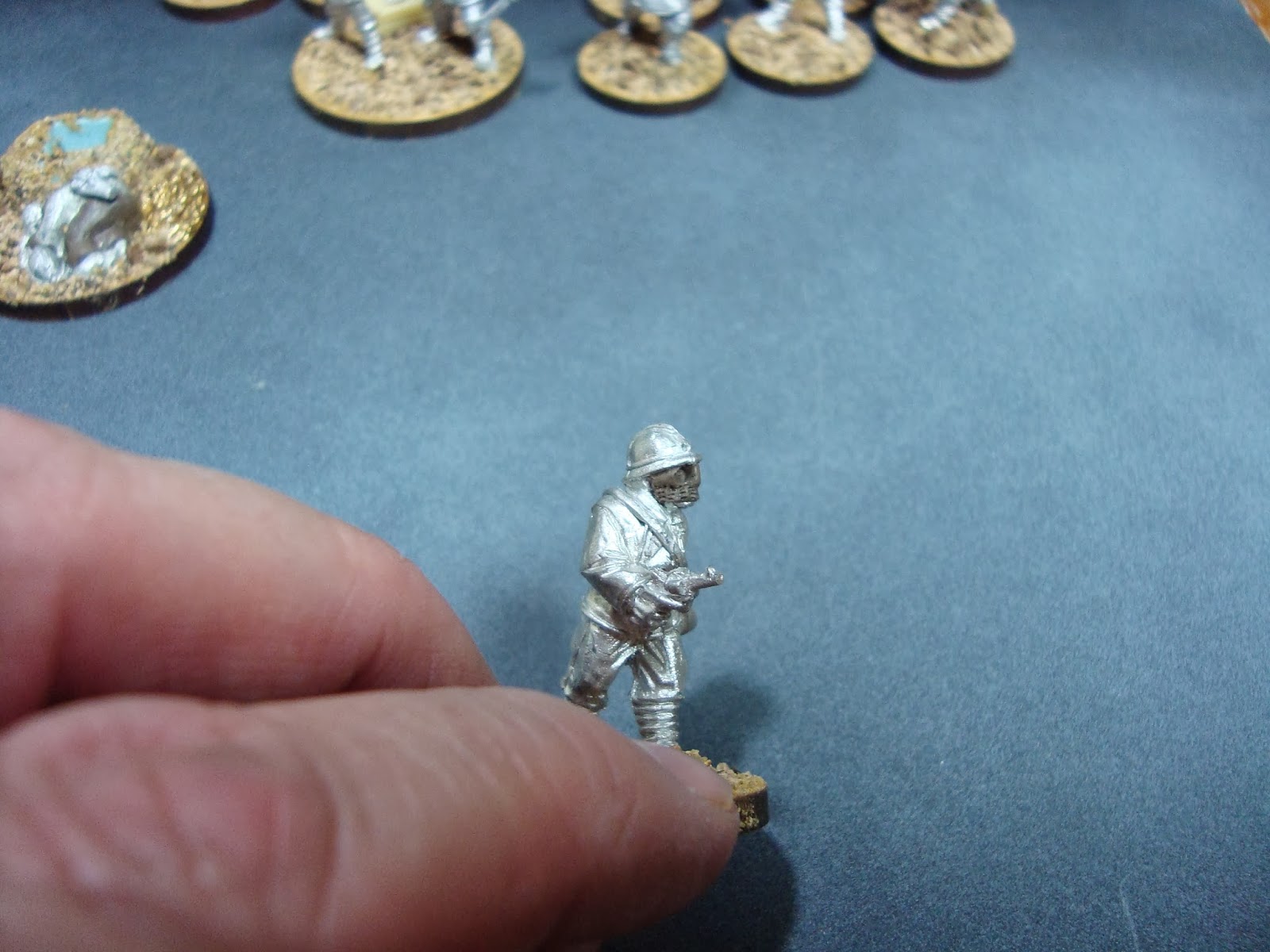
Three have been enlisted into the ranks of French tank crews from the Artillerie Spéciale – more of this to come later this year, but suffice to say that I’ve purchased enough French tanks to form a small force from the Nivelle Offensive at Berry-au-Bac in April 1917. I’m hoping to paint these up in November and December, so watch this space. Sadly, only one manufacturer makes French tank crew – which are the Old Glory figures featured here. This is a great shame as the heroics of the French Artillerie Spéciale are inspiring and very interesting material for any game. Anyone wanting French tank crewmen with British Tank-Corps style face masks (such as the one shown in the Osprey French tanks of World War One volume), has to resort to green- or brown-stuff versions.


The wounded/ shock markers are from generic casualty figures I bought a while back from Silent Invader at the Lead Adventure Forum. Regular visitors to this blog might remember these from British and German casualty projects in the past.


The remaining figures eleven figures I converted as Tirailleurs Marocains, using the Woodbine miniatures’ Zouave heads. I was really pleased how easy these were to use. Simply saw off the head of the figure, drill a hole and insert the new head. I added a collar of brown-stuff on most of the figures to disguise the join. I sawed off the helmets as well and added these to the Zouaves’ field packs to try and give the figures a Late War “feel”. I’m very much aware that any sensible Tirailleur would have worn his Adrien helmet in action, and depicting the Zouaves in their dress caps is probably viewed by many as a crazy affectation. I admit it – you’re right. It’s unhistorical, but I liked the appearance. And since I’m unlikely to do an Early War French army any time soon, this was my only chance. So, confession over, here’s how they lined up post-conversion:


You may be wondering what on earth I am going to do with just eleven Tirailleurs Marocains!!

It’s a fair question, mes braves, but I’m sure there’s a scenario they can fit into. Perhaps as a group of Tirailleurs pinned down in No Man’s Land, or as a bunch of stragglers, or as a scouting patrol. I’d not be surprised if they end up being used more than the typical Pinard-drinking Poilu!

And why the Tirailleurs Marocains in particular?  Almost entirely because some of the Moroccan regiments seems to have been equipped with Horizon Bleu uniforms throughout the war, as opposed to being equipped with khaki uniforms (as were more common for the French African regiments). That, and they offer just a glimpse of the huge contribution to the French war effort made by African soldiers in the Great War. With that in mind, it was very hard to resist their allure for the wargames table....


I’ve still got a platoon of Tirailleurs Sénégalaise to paint, but they’ll be lucky to get painted this side of Christmas.

Next up will be the next instalment In our Chain of Command Campaign, so here’s hoping you can join me for that. Have a great weekend!

Wednesday, 29 August 2012

Great War German Casualty Bases


You might remember that earlier this year I prepared a pair of British stretcher bearers and a handful of British casualties for use in our games of “Through the Mud and theBlood”.   It’s taken a while to do the same for the German forces, but in this post I’ve blogged the matching German casualty bases.


On each of the bases I tried to make a small impression to place a micro-dice into,  This serves to denote “shock” in the wargame, a feature which generally inhibits or restricts the actions of the unit suffering the “shock”.  We found in a lot of games that the micro-dice can get knocked over, hence the need for an impression in the base in which the micro-dice could be stored.  Kudos again to Curt from Analogue Hobbies for coming up with this fantastic idea.


Wednesday, 20 June 2012

"Das Rattenloch" – Part 4: The Defenders of the Position


With sincere apologies in advance for yet more mangled German, this blog post introduced the occupants of das Rattenloch. What I wanted to try and do as part of the project was to integrate a small number of figures closely into the terrain. I would have one section to deploy intact into the bunker itself, and another couple of sections and support weapons which could be deployed into the position once the bunker was destroyed. The German defenders would be position defenders, or Stellungsbattalionkämpferer - far from the elite of the German army, but still more than capable of clinging on grimly in the face of repeated British attacks.


I was quite taken with the idea of trying to match the painting of the German defenders with the painting of the bunker (of which more in a future Blog post) and to try and match up the bases on the figures with the terrain in which the bunker is located. I thought this would probably be simple enough for the Stellungsbattalionkämpferer occupying the intact bunker position, but perhaps a little more challenging for the troops who would be occupying the destroyed version of the bunker which I’m currently building.

This might not make a huge amount of sense to you all right now, but please hang in there.  It should become clear eventually!

Wednesday, 28 March 2012

British Stretcher Bearers and Casualties of War


One of the things I’ve been working on during the last couple of weeks are a couple of sets of stretcher bearers from 1st Corps Miniatures. These are very characterful sculpts and fit together very easily with no flash. The casualty is glued to a stretcher, and the stretcher fits neatly onto the two stretcher bearers. Each set is a very reasonable £4.00 (plus P&P). The figures look excellent alongside Great War Miniatures’ British infantry and figures from the Great War ranges of Gripping Beast and Musketeer Miniatures. However, I also think that you would have no trouble fielding them along Renegade Miniatures’ Great War ranges also.


I was especially pleased that one of the stretcher bearers is wearing trench waders, which seem to be very authentically sculpted. The very evocative photograph of trench waders being worn by a medical team “somewhere in France” is featured on the excellent Great War Photos blog by Paul Reed.


Regimental Stretcher Bearers would have had the task of recovering soldiers from the battlefield and taking them back to the Regimental Aid Post for medical assistance, so I made sure that the stretcher bearers were equipped and uniformed to fit alongside my combatant figures. As regards equipment, the stretcher bearers seemed to have carried very little in action except a water bottle, gas mask, and shrapnel helmet. No doubt the weight of the casualty was quite enough. As Harold Chaplin pointed out in a letter to Alice Chaplin in May 1915: "It took six of us to carry one man. You have no idea of the physical fatigue entailed in carrying a twelve stone man a thousand yards across muddy fields."

As for numbers, according to the "British Army Handbook 1914-1918" by Andrew Rawson, "At the start of the Great War a Battalion's RAMC Officer ran the Regimental aid post, aided by two orderlies and 16 stretcher bearers. In 1915 they were doubled to 32.....". Not every man carrying a stretcher would be medically trained – some would just have been detailed to collect the wounded, and prisoners of war would often be recruited in this activity as well.


I also wanted to try and make up some additional casualty bases for my Great War British forces. These use Curt’s fantastic method of building a small impression to place a micro-dice into. I did seven, although in all honesty I could happily have done more.


The dice holders are made out of scraps of offcut Styrofoam, cut according to th size of the micro-dice you want to use.


The larger bases accommodate the British Casualties set from Great War Miniatures, whereas the smaller bases features some converted “generic casualties” from Steve (Silent Invader) on the splendid Lead Adventure Forum.

And here’s a photo of the new casualty bases with some of the older ones which I made a year or so ago, complete with barbed wire …


I’m still figuring out how best to use the stretcher bearers in a game, and need to try out some additional rules for them at my local club to fit into the "Through the Mud and the Blood" rules from TooFatLardies. However, the bravery and determination of these soldiers, and other non-combatants in that role (such as conscientious objectors and Quakers), is something I would very much like to represent in our games.
Related Posts Plugin for WordPress, Blogger...