Sunday, 13 March 2011

Thirty Years Ago …

I don’t remember precisely where I bought it, except that it was somewhere in Hull. I do remember when it was – sometime in February 1981. It was my first wargaming magazine. I have a dim memory of hunting through the magazine shelves to find it. It was on the other side of the shelves from the Radio Times, and absolutely nowhere near the comics I usually bought.


At first sight it really didn’t look very inspiring. “Military Modelling”. A picture of what I thought looked like a pretty unexciting Bren Gun Carrier on the front cover. I didn’t want detailed transports, I wanted wargames figures. Where on earth were they? I felt a little cheated, but after all I had been told by Mr Farrar, the teacher at school who ran the wargames club, that “Military Modelling” was the magazine I should get if I wanted wargames figures. I wasn’t going to argue with that.

When I got home, and looked through the magazine, I realised what Mr Farrar was on about. It wasn’t so much the feature articles (Painting Tartans, British Light Cavalry Equipment 1800-1815), as the shorter articles which got me excited. Wargames Briefing, Across the Board, Observation Post … these were articles about wargaming, about how to get started, about what to buy, and about what was good and what was really good.

And there were adverts. Lots of adverts. They sold everything from D&D miniatures (CF1 Cleric with Mace – 25 pence), to micro scale infantry (85 pence for 50 Saxon Fyrd) to a mail order company called Games Workshop selling everyone else’s board games and just three or four of their own. I wonder what happened to those guys?

I didn’t make a note of how long I read the February 1981 copy of “Military Modelling”, but I don’t think I’ve ever read a magazine quite as closely. I knew where every advert was on every page, and knew as much about painting tartans and “The Miniatures of Pete Kailus” as the good Mr Kailus himself possibly.

After I’d read the magazine, my friends from the school wargames club read it. And, in the end, after long discussions we worked out what we were going to buy. By that time the original magazine had started to fall apart, the front cover got ripped in a school bag and someone started writing in the margins which figures they wanted. So the photos here are from a copy I picked up on Ebay in a flush of nostalgia in January.

And what did we buy? Oh yes, well, here they are – the very first wargames figures I ever painted.

They're 25mm Lamming Miniatures medievals. Although the Lamming Miniatures advert in the magazine is deeply uninspiring and mentioned only “multi-purpose figures”, Bill Lamming’s workshop was close by in Hull and Bill’s advert gave his telephone number. We’d seem Bill’s figures at the school club (thank you again, Mr Farrar !) and we’d wanted to get our own. Me and my friend Mike cycled across Hull to the workshop in Wincolmlee on a cold March morning Saturday morning, and collected a package of figures each. I didn’t realise it at the time, but these were the very first foothills of the lead mountain, and the start of a hobby which I would love for the rest of my life.

And, alongside the first figures I painted, are the most recent ones from the trench raiders project which I’ve just finished yesterday. Ok, so sculpting, basing, paints and painting have come along a bit in the last thirty years, but there’s no way I am ever parting with the old timers.


Thirty years in, and no sign of stopping now !

Wednesday, 23 February 2011

"Winter Sports": The Wiring Party

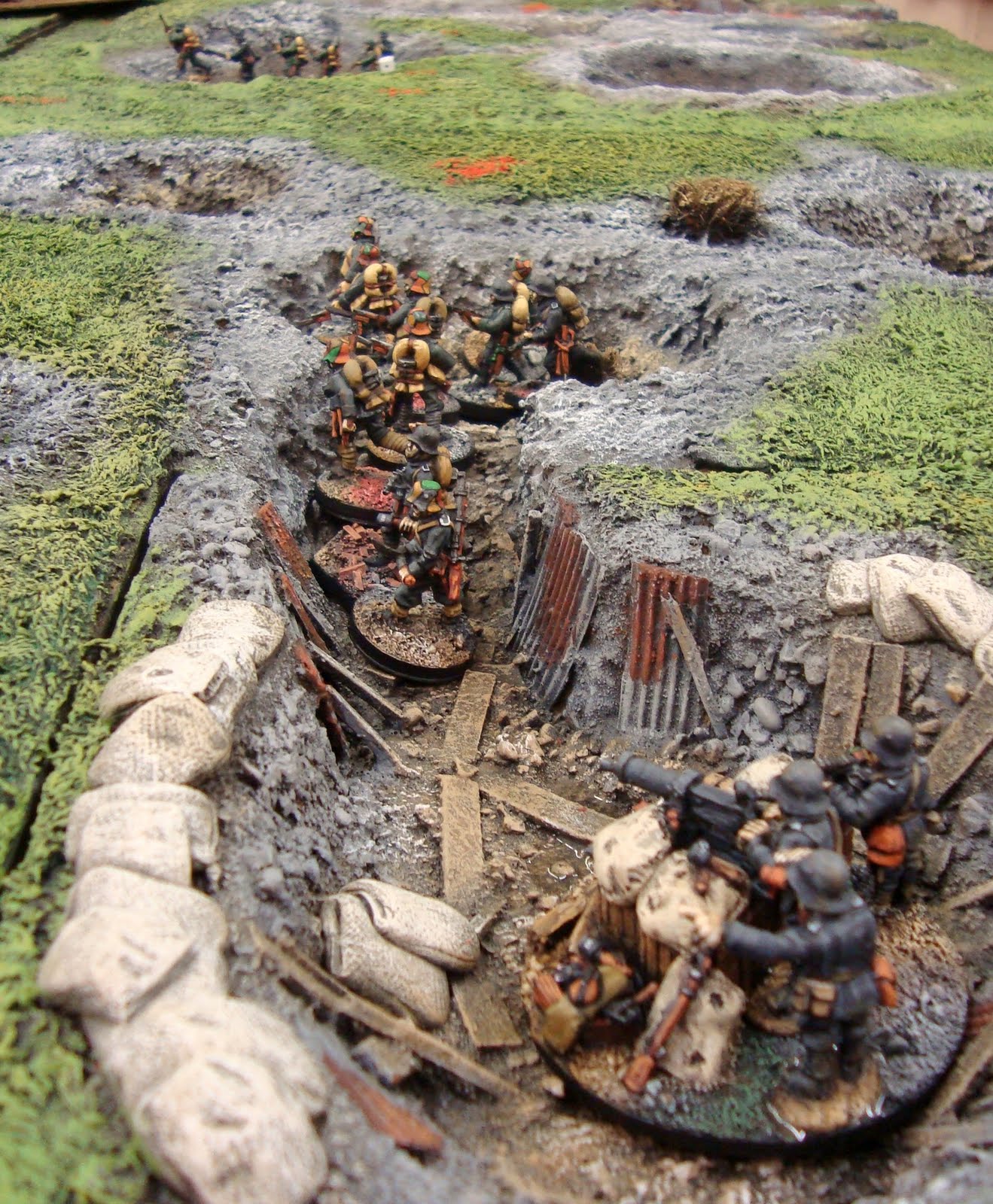
We played through another of our trench raiding “Winter Sports” games last night, this one being “The Wiring Party”. Unlike the other trench raids over Christmas, this game was not part of the original “Winter Sports” article but was one of a number of new scenarios we are play-testing which I’m hoping to make into a mini-campaign focusing on some of the minor actions of a battalion on the front line in the Great War. I also tried to include a “game within a game”, focusing on the search for a wounded officer led by an inspirational Anglican Chaplain, but more of that in a minute!

First, a little by way of introduction. Wiring duties were probably one of the least popular tasks for troops in the trenches. Barbed wire defences needed to be maintained constantly, whether from shelling, attempts of the enemy to damage or destroy the wire at night, or just to keep the wire clear of any bodies. A wiring party would be formed under the command of an NCO and, under the cover of darkness, would leave the trenches to perform maintenance on their wires, as well as investigation of the status of the enemy's own wire. From time to time, these wiring parties might be accompanied by an attempt to rescue wounded survivors from a recent attack. It was far from unusual for wiring parties to meet their enemy counterparts in no man’s land and for fierce hand-to-hand fighting to take place, accompanied by machine gun fire, flares, star shells and sometimes trench mortar or artillery barrages.

The game started at the end of a tough days fighting. A British Division’s attack on strongly held German lines had not gone as well as expected. While the British assault battalions had carried the first line of German trenches, the second line has remained in German hands. The German second line is protected by a belt of wire which has been damaged in the initial British barrage. The new “No Man’s Land” between the first and second German lines is now littered with the bodies of both the British and German fallen.

The picture below shows the table I came up with. The paper squares indicate the location of wounded soldiers in No Man’s land who need rescuing.


The primary mission for the British commander, Second Lieutenant Jasper Whitechapel (played by Elton), was to discover the strength of the German wire and prevent the enemy’s wiring parties from effecting repairs. The British player also was aware that his inspirational company commander, Captain Rupert Romford, was missing after the attack earlier in the day. The British player was told that, if at all possible, Lieutenant Whitechapel and his troops would want to rescue their commander from a grim fate in No Man’s Land. In that mission, the British player could call on a very special Big Man, The Reverend Charles Upton-Park better known as “Capstan Charlie”, and two RAMC stretcher bearers.

The German commander, Feldwebel Lothar Schmidt (played by Big Al), was tasked with leading a small team of pioneers into No Man’s Land to repair the wire, under the protection of a platoon of grenadiers.

Both players were told that once fighting hard started and once the alarm was raised, they could call on the support of a machine gun firing on a fixed line and, for the German player, a Granatenwerfer 16.

The game opened with two British sections, including one Lewis gun, moving swiftly forward on “blinds”, quickly occupying Camden Copse.

A section of engineers and trench raiders advanced to try and scout the enemy wire....

....while a section of bombers advanced to the right of the wood under Corporal Vince Shadwell, feeling for further gaps in the wire in the darkness.

The German defenders quickly opened up with rifle fire on Corporal Shadwell’s position, although a supporting party of German soldiers under Gefreiter Johann Kleist was quickly pinned down the Lewis gun firing from Camden Copse.

On the German right, Gefreiter Rudi Vogel had pushed forward with a group of pioneers into Crow Wood aiming, optimistically considering the carnage unfolding, to commence re-wiring across the German front line.

In amidst the chaos of starshells and flares being fired into the night sky, Gefreiter Vogel stumbled across a badly wounded British Officer in Crow Wood. It was Captain Romford. The Captain was quickly escorted, minus pocket-watch, to the German trench line. As the identities of the wounded soldiers were randomised in the scenario, the fact that Captain Romford appeared across the German wire and in Crow Wood made the British task of capturing him pretty much impossible. Mea culpa, on my part – well, I did mention this was a play test!

On the British side of the battlefield, great and noble things were being done by “Capstan Charlie”. The first “wounded soldier” he attended to was, sadly, already dead. The second, Private Alf Bethnal, was badly wounded and was taken by the stretcher bearers back to the British lines. At this point, “Capstan Charlie” proceeded under fire to attend upon a mortally wounded German soldier in an exposed area of No Man’s Land in an attempt to administer the Last Sacrament.

While the brave Chaplain went about his business, both British and German machine guns firing in a sustained fire role were deployed (the German in their trench, the British off-table but marked with a model). While neither fired many times owing to the need to avoid hitting their own troops, the fire power they deployed neatly bisected the table, pinning down a number of opposing groups. The deployment of the German Granatenwerfer 16 also added to the discomfort of a couple of British sections sheltering in shell craters.


With casualties amongst the sections closest to each other mounting, both a British and a German section lost their “bottle” after loosing their junior NCOs, and both sides started to disengage from the vicious fire-fight. As “Capstan Charlie” administered the Last Sacrament and cast his eyes around the battlefield for other soldiers to help, the game drew to a close with growing casualties on all sides.

So, an enjoyable game, played in a great spirit by Big AL and Elton, but one which needs a little tinkering with as regards a number of scenario features. I felt that expecting the German player to fight forward to repair the wire was very challenging. The game would be better started with the German pioneers working on the wire, under cover of their platoon or sections, and being disturbed by the British. The sustained fire machine guns would have totally dominated the later stages of the game had it not been for intervening friendly forces, and this probably contributed to the final stalemate.

Finally, I was pleased with the introduction of “Capstan Charlie” into the game. While the rules need a bit of work, I liked the addition of a non-combatant into the game, particularly where he might be able to commandeer a couple of otherwise-fighting troops to help him recover wounded from the battlefield. For those interested, “Capstan Charlie” is modelled (with great respect) on the historical figure of "Woodbine Willie". More details of some of the remarkable chaplains of the Great War are available here.


Wednesday, 9 February 2011

Roundwood's Wordle

One of my favourite wargaming blogs is Big Lee’s Wargaming Adventures. In addition to a succession of topical, hobbying, wargaming or modelling posts, Lee sometimes throws a complete curve-ball in. His post today on Wordle was one of these. The temptation to do one myself was too great!

Here’s the blurb from the Wordle site: ‘Wordle is a toy for generating “word clouds” from text that you provide. The clouds give greater prominence to words that appear more frequently in the source text.’

I plugged in Roundwood’s World, and this was what I got, in suitably earthy, Great War muted tones.


Making the word cloud was a lot of fun, and I liked the final result. So, a short blog post from me today, but hopefully enough to recommend both Wordle and Big Lee’s blog. Give them both a go!

Tuesday, 8 February 2011

“Winter Sports”: Snipers

A few people out there might know that I’ve been working on adapting the “Winter Sports” article which Richard Clarke wrote for “Through the Mud and the Blood” into a larger mini-campaign in which the player, or players, take command of a platoon or company in the trenches on the Western Front. One of the aspects I’d like to include are the smaller missions and actions which an almost daily occurrence for the troops in the front line. Within that group I’m hoping to include a mission or two focusing on sniping.


I wasn’t previously aware that (like so much of the action in the War) sniping, and counter-sniping, evolved its own complex patterns and tactics. Sniping could disrupt formations under fire, inflict casualties and wreck any chance of an easy truce evolving between the front lines.

As one soldier wrote “The sniper is a very necessary person. He serves to remind us we are at war. Wherever a head, or anything resembling a head, shows itself, he fires. Were it not for his enthusiasm, both sides would be sitting upon their respective parapets regarding each other with frank curiosity, and that would never do” (“Trench Warfare: The Live and Let Live System”, page 57).

So, I felt I needed some snipers. There are some fine ones available from Great War Miniatures – four very nice German snipers and a British counterpart (which I’ve not yet painted). I also really like the British sniper set available from 1st Corps (which paint up well as snipers of any nationality). At first, I thought that the figures looked a little bit contemporary. However, a lot of the photos in the books mentioned below show that the art of camouflage was well understood by Great War snipers, with “ghillie suits” and loose hessian robes sewn with grass and tufts of green and brown material being worn by both snipers on both sides.

Here’s the 1st Corps snipers in unpainted form:


And here's two finished 1st Corps snipers painted as Germans with the Great War Miniatures German sniper set:


And here's the British snipers to balance up the numbers:

I tried to make sure that the snipers were painted in some random early camouflage pattern but, reasoning that there probably was no “pattern” as such, I just made it up.


I found the most useful and interesting book about sniping and sniper tactics to be Major H Hesketh-Pritchard’s “Sniping in France”, an auto-biographical account of establishing British sniping schools. Peter Senich’s “The German Sniper 1914-1945” was also good, but with far more material on the Second World War than the First. The Osprey “Military Sniper since 1914” by Martin Pegler is a handsome book, but his “Sniping in the Great War” adds much more detail, especially about the Commonwealth snipers.


“Through the Mud and the Blood” covers snipers and their weapons in a fairly abstract way, which I do not suggest anyone changes. But the individual art of sniping, although fascinating, is just part of a wider story of how snipers were deployed, and countered. I hope to offer more about that wider story in future blog posts.

Monday, 24 January 2011

WIP – British Trench Raiders 1917

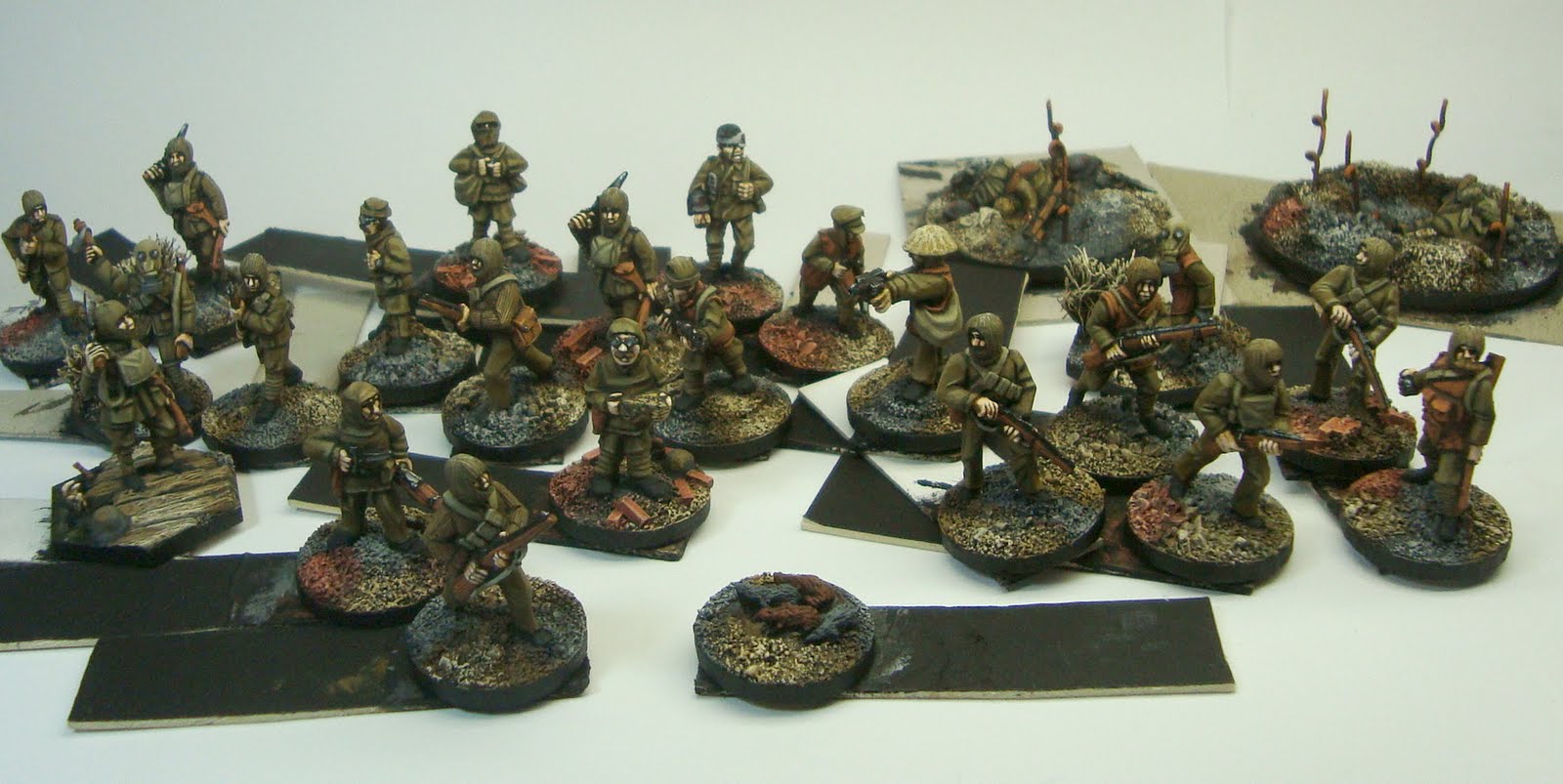
I thought I’d post a few pictures of some British trench raiders which I’ve been painting in the past couple of weeks, really to keep my momentum up during the long, cold January months for my “Winter Sports” trench raiding project.


I’ve enjoyed painting these guys. They’ve made a real change from simple British and German infantry. I’ve photographed 22 of the figures – there are another 10 to finish off, plus a Vickers machine gun to give long range covering fire if the British attacker is fortunate enough to get the use of that weapon in the pre-raid “Winter Sports” troop allocation. I’ve then got about 20 German trench raiders, which I’ve not yet started.


The standing figures in the photographs are from Great War Miniatures, Musketeer Miniatures and First Corps. The casualty figures are the excellent ‘generic casualty’ from Silent Invader from the Lead Adventure Forum, with the addition of some weapons, helmets and backpacks from MaxMini and The Assault Group. The swarm of trench rats were from Irregular Miniatures.

While the first two manufacturers are well know for their Great War subjects, I don’t think that First Corps have got the same following....at least not yet. I found the First Corps figures (available at www.1stcorps.co.uk) very clean and well cast, size-compatible with Musketeer and Great War Miniatures and very reasonably priced. Delivery was very fast, and certainly within one week to mainland UK. The figures are characterful and easy to paint. They don’t have the same intricate surface detail as Musketeer and Great War Miniatures, and the sculpting is not as fine. However, they look good (at least to my eye) when painted. See what you think. Once I have finished all the raiding teams, I’ll do a shot of the First Corps figures so you can judge them against the others for yourselves.

The figure holding a map in the photograph above is a First Corps figure and to my mind is a great sculpt – reading a map as he tries to navigate through No Mans Land by the light of starshells.

The British trench raiders in the photos are about at the 90% finished stage, just requiring varnishing and the addition of a little more detail on their bases. On quite a few of the bases you can spot barbed wire picket poles of the type which would have been present in No Mans Land in front of trench lines. I went a bit over the top on adding extra poles onto the casualty bases. I hope to post a few more pictures next time of the different sorts of barbed wire you can use on bases when I finish the figures later this week.

Finally, as this is a WIP post, I've posted a couple of pictures of where I started out with these figures just before New Year. You can get a glimpse of the Vickers machine gun team, and some of the German trench raiders, as well as some of the British trench raiders I've not yet finished...


Wednesday, 19 January 2011

“Peaceful Penetration”: Winter Sports, Game 2

This was the second of our “Winter Sports” trench raiding games played just before Christmas using the “Through the Mud and the Blood” rules from TooFatLardies. We used the article by Richard Clarke, “Winter Sports”, featured in the TooFatLardies Christmas Special which Richard brought out in December.


The British raiders in this second raid rolled the “Peaceful Penetrattion” mission. The aim in the raid was for the attacker to capture and occupy a 12” section of the defender’s trench and hold it against an enemy counter-attack for a set period of time until reinforcements had arrived. The scenario was taken from an Australian tactic which was developed towards the end of the War as an alternative to a daylight frontal assault on German front line trenches. The concept was for small raiding parties to infiltrate into the outpost line of the German defences, which were by then organised in depth and over a series of Stellungen and defensive positions rather than being focused solely on linear barriers. The Australian’s idea was to penetrate the German defences at night, and for the raiders to be quickly reinforced by substantial forces in darkness thereby avoiding the need for long preliminary bombardments.

The scenario we played included a few of these elements. The Australian players took a small raiding team of 27 Australian figures. Unlike the first trench raid game we played through before Christmas (see my earlier blog post), the attackers (the Australians) did not attempt a crossing of No Man’s Land at all points of the table. Instead, the Australian commander cunningly chose to ‘purchase’ an additional NCO in place of a couple of privates and split his forces into three groups (each led by an NCO) with a junior officer leading all three groups forward in a single concentrated assault on a small part of the German front line.


Purchasing the extra NCO allowed each of the small raiding groups to be led by a ‘Big Man’ , thereby freeing-up the junior officer of the raiding party to use his initiative under the rules to deceive the enemy sentries into thinking nothing was amiss (by reducing the number of spotting and “whistleblowing” points which the Germans were accumulating in the game). A cunning approach, well worthy of the most determined and tricky Australian on the Western Front!

Against the raiders was a small force of German Stellungsbattalionkämpfer defenders garrisoning the line and a force of 26 Eingreiftruppen to reinforce the German defenders once a general alarm had been raised.

The Australian tactic of using their Officer Big Man to reduce the successful German spotting, or “whistleblowing” rolls, worked extremely well. So well, in fact, that the Australians were able to penetrate into the German trench without being spotted and despatching one of the three German sentries assisted, it has to be said, by a woeful set of dice-rolling by the German players.


Instead of the general bumbling about of Lieutenant Carshalton in the first game, the Australian players really stepped up to the crease as they peacefully penetrated the German’s front line trench.


Dropping down off the parapet, the Australian Officer, Captain Murdoch, was able to deploy his “ferret” into a German bunker occupied by an section of the German Stellungsbattalionkämpfer which had not been alerted.


The “ferret” in question was a ferret bomb, an explosive device rigged up by the Royal Engineers consisting of 8 slabs of guncotton and encased with shaped wooden panels which had been rounded so that the charge could be rolled down a dugout without lodging on the steps. Rather than facing the “ferret” rolling down the steps of the bunker, the first section of German defenders, perhaps wisely, chose to surrender.

By now the commotion in the front line trench had generally alerted the other German defenders, bringnig Captain Murdoch face to face with the Hun....


The resulting fighting in turn heralded the arrival of Gefreiter Artur Sturm and two detachments of Eingreiftruppen to challenge the Australian penetration.


However, by the time German Eingreiftruppen had started to arrive from the communications trenches, the Australians had already held the enemy trench for half the time required to achieve a victory. The alerting of a German MG08 Maxim machine gun team in a bunker threatened at one point to unbalance the Australians’ success. However, after a grim struggle ensued, the Australians held on to launch their flares and obtain reinforcements.


We had an interesting debate during and after the game concerning the entry points for the Eingreiftruppen reinforcements. The German players had pre-determined the entry points as being the communications trenches. If the German players had brought their reinforcements in over the top of the trench network, allowing them to drop into the middle of the front line trench, the result could well have been very different, as the result would have been to split the raiding forces into two smaller groups, as the overhead photo below shows. It would have been a bold tactic, but very much in keeping with the traditions of the Stosstruppen. Perhaps this tactic will happen on other trench raids....stay posted on that thought!!


All in all, a really enjoyable game, and an undoubtedly better result for the Australians than the Ashes! I’m a little behind with posting games and new figures, so I shall try and catch up over the next few days with a blog post about what’s been on my painting table so far this year.

Saturday, 1 January 2011

A Very Happy New Year 2011

A very happy new year to everyone out there! And my very best wishes for 2011.


2010 was a pretty good wargaming year for me. Of course, there was a lot I planned which I didn’t get round to, but the balance was firmly on the positive side of the wargaming ledger. Right up at the top of the achievements ledger was meeting some new gaming friends at the St Albans club and at shows like Salute, SELWG and Burton. For me, sharing experiences with old wargaming friends, getting figures on the tabletop, playing games and welcoming new members to a wargames club or group are what the hobby is all about for me.

This year I also started this Blog. I’d like to thank everyone who’s followed, commented and read it. The comments and things people have said have been really appreciated – each and every one of them! What started out as somewhere to post a tutorial about building trench terrain has become a bit of a focus for what’s going on in my wargaming hobby. It’s added a huge dimension to my modelling, terrain building, painting and gaming and I’m really looking to continuing it in 2011. I’d also like to say a HUGE thanks to the other blogs and podcasts out there in the wargames community, whether historical, fantasy, sci-fi or RPG which have inspired me this year. There’s too many to mention, but some of my favourites Blogs are listed on the right hand of this page under “Great Wargaming Blogs”. Again, Ladies and Gentlemen, thank you for all the inspiration! I only hope I can give something back…

So, what’s in store for 2011? Well, I’m usually a bit nervous about predictions and New Year’s Resolutions. However, what I am hoping to do first is post two or three battle reports in the next couple of weeks covering some more of our trench raiding games over the Christmas and New Year period.


I’ll be blogging photos of some new trench raider figures I’ve finished recently and some no-man’s land terrain boards which I’ve been working on for these games.


Towards February and March, I’m intending to do a successor modelling project to last Autumn’s “B” Battalion of the Tank Corps. The focus in the Spring of 2011 is going to be on a troop of Lord Strathcona’s Horse from Moreuil Wood in March, 1918. I think cavalry have been slightly overlooked in Great War wargaming, and I hope I can persuade a few people to look again at this really interesting dimension on the battlefield.

Later in the year I hope to be play-testing some divisional scale Great War rules based on, and evolving from, TooFatLardies’s rules for the Great War in the Middle East, “If the Lord Spares Us”. Richard Clarke and myself have been building armies in 10mm scale for this, with the Germans finished and the French and British still to go. I’ll be putting some terrain together for these rules, which I’m hoping will be fun to do.

Finally, the ‘Big Project’ for this year will be a new army, probably starting after the summer. I’ve a French army from Scarab Miniatures waiting patiently in the painting queue, but Great War Miniatures’ Americans from Belleau Wood and the Meuse-Argonne are looking very tempting.

Whatever happens, it should be fun. And however you spend your 2011, I hope it will be healthy, happy and filled with great wargames.
Related Posts Plugin for WordPress, Blogger...