Thursday, 31 October 2013

The Road to Antwerp – Crisis 2013

Just a brief update to mention that by this time tomorrow I shall be on the road to Antwerp with Richard, Biffo and Noddy, heading to the Crisis 2013 show on Saturday hosted by the Tin Soldiers of Antwerp.


This has been one of the highlights of my wargaming year since 2009 and is always a great show, bringing the very best of European wargaming together in one place. Added to this hobby incentive is the city of Antwerp itself, surely one of the most attractive of North European cities and always very welcoming.

After last year’s disastrous work avalanche which prevented me getting to Crisis 2012, I’ve had an equally frantic October 2013 but after several late nights in the office, the coast is clear for an early departure tomorrow.

This year’s game will (I understand) be “Chain of Command” in the Western Desert. I’ve dusted off some desert terrain from a few years back specially.


"Ahh…….Effendi…come closer, please…..I am seeing just how wonderful these fine carpets would look in your English Mansion….very reasonably priced and they would most certainly fit perfectly on the back of your armoured car …..I see you are interested in the delicious selection of dried fruits and eggs which my third wife has assembled at her stall….please....try one….delicious….yes?"

I understand my fellow travelling companions have assembled some more ... er ... military themed figures and terrain.

I very much look forward to seeing a few of you this weekend!

Tot binnenkort!

Sunday, 13 October 2013

The Verdun Project: French Cards for "Through the Mud and the Blood"

As readers of this blog will know, I enjoy using the TooFat Lardies rules for "Through the Mud and the Blood" for the Great War games which I run and play in.  One of the things which is needed is a set of cards for the various leaders, support weapons, vehicles and command units on each side.  I'd produced a set of cards for the British and German forces a couple of years back, and I felt it was only fitting for me to prepare a set of cards for French forces as well.


I've therefore  uploaded a new set of cards for "Through the Mud and the Blood" on the blog.  These are a set of cards for French forces, mainly focused on the later years of the Great War.  They should be suitable for 1916 onwards.

I replaced the card for "The Devil's Luck" with a card entitled "Veine de pendu", which I hope means almost the same thing.  If that's not the case, please do let me know!  At this point I've not added cards for the Tirailleurs Marocains or the Tirailleurs Senegalais - I'll wait until the figures for these units are painted before adding these cards in version 2.

I've uploaded the French cards on the blog in the section headed "Playtesting Scenarios, Campaign Diaries, Play-Aids and Painting Guides".  You can find this on the right-hand side of the screen, just above the list of other great blogs I follow. I have also uploaded a set of British and German cards (which are slightly updated from last year's version) and a set of General cards for "Through the Mud and the Blood".  I've shared all of the documents in Google Drive, so hopefully you can all get access.

Please let me know if you have any difficulties accessing any of them.

Making the cards isn't difficult.  I printed off the card-faces on a colour printer, and prepared a card back for each of them - I used the famous image of Lord Kitchener, and added a little photo manipulation.


I then glued the card front and back together and ran the glued cards through a laminator using gloss pockets.  It's a bit more fiddly than sending your designs off to Artscow (who make lovely cards), but I like doing it and it gives me the chance to add a lot of cards which I might not bother with if I was sending away for a card pack to be produced.

Just a quick mention to say that the artistic textures on all the cards were kindly made available for free by a wonderful New Zealand artist, Borealnz.  Her Flickr page is a gold-mine of very generously provided textures, which I recommend as a great way to get started in designing your own cards.   The font on the French cards is Megaopolis Extra, again generously provided for free by Smeltery HERE.   Thanks to both Borealnz and Smeltery for their generosity.


Have a go, as I was surprised how much fun making own cards was.


Tuesday, 8 October 2013

Campaigning with Chain of Command - Rules and Mechanics

For those of you still reading the Blog posts I've produced in respect of our "Chain of Command" games at the St Albans Wargames Club (thank you - here's some more of the tablets!), you may be interested in today's post on Lard Island News.


Richard has posted a brief description of the backgrounds of the various Leaders we're using in the campaign. As Richard wrote the "Chain of Command" rules and is writing the campaign supplement, you can rest assured that his descriptions of the campaign mechanics will be far more reliable than mine!

With that in mind, please let me direct you to Lard Island News HERE.

As for Richard's description of my Blog posts as the "deranged wanderings of the fevered mind that is La Roundwood", I think that's actually not far from the truth!

Our next campaign game is this evening, so hope you can join Richard and myself for the after action report (wherever it may appear!).


Monday, 7 October 2013

Chain of Command Campaign: Game 3 - Attack and Defend


Sometimes the battlefield seemed empty to Second Lieutenant Sandy St Clair. If not silent, or still, then waiting. Like a cold, dark river on an early autumn morning in Perthshire, a lifetime ago. Before. The. War. A different life, a different world.


Unlike the heather clad glen and nearby pine woods of his Uncle's estate in Scotland, the hill before him stank. A crop of bloated dead cattle filled the fields, a harvest of splintered iron shells having scythed them down before his platoon arrived.

The smell of their carcasses made him retch. It was all he could do to train his field glasses on the stone walls which led to the Enemy's main defence line. Not silent, not still, but waiting.

He was holding his nerve. People were pleased with him. His platoon had been fighting well. The scrappy, yellow paper scrawled with his Colonel's commendation was fast turning a smudged, mottled black as he fingered it repeatedly in his pocket. Words on a paper letter. Not much to cling to, but better than a vague, random hope he'd pull through.

Stop it. STOP THINKING LIKE THAT.

He could feel the sweat leeching slowly around his thick woollen collar. He checked his watch. He'd been in the farmhouse with a section for five minutes now. Nothing to see in the fields. He'd tried. His eyes ached. He couldn't even see the swarms of flies glutting themselves on the slaughtered cattle. He could tell the Bren gunners were edgy as well, one of them rubbing the edge of the spare magazine like a child's toy. 

 
He felt the rumble of the Cromwell before he saw or heard it. He'd waved it along the side road as he'd approached the house, hoping that it would have a decent field of fire to the north of the farm.

Sergeant McKie's section was moving up to the south. Pin, Pivot, Punch. Concentrate. Try and remember, just try and remember. They're all counting on you. He searched his watch's face, suddenly nervous.  He thought it had stopped and then watched the hands slowly moving.  Playing tricks again.  He always knew that some seconds lasted longer than others. Another ten seconds nearer The End.


Then it started. Automatic weapons, machine guns, mortars, the rasp of chemical smoke in the back of his throat, the brick splinters spraying from the walls under fire, the screams and the shouting, the thud of artillery support strolling closer, killing almost casually. Obliteration at less than 2 feet away. 


The Bren gunner almost growled as he was shot. The upstairs window had given a perfect field of fire, and offered a perfect target. Before he could grab the gun, a second man was shot, the stock now slick scarlet with their conjoined blood. He was waving for McKie's section to leave the field, find cover. The enemy fire was ferocious. Somehow he still managed to shout orders, his feet unable to move, his hand slashed by a brick splinter from the window. He knew he was shouting as much out of anger as fear. 


The rumble got louder. At first he thought that Evans had ploughed the tank into the farm. Everything shook. A picture fell from the wall and he realised for a half-second someone had lived here. A bedroom overlooking a field, by an orchard. Someone had slept, been happy here. Now it was a morgue.


He heard the crash as the Cromwell ploughed a furrow through the stone wall to the south of the farm, the sound of wrenched, scraped, metal screeched insistently in his head and refused to stop. The tank had bogged. The Enemy had gone. It was suddenly over. The ghosts of their feldgrau and camouflaged smocks vanishing in the smoke, leaving him with the dead, the blood and the finally silent room.

******************************************************************

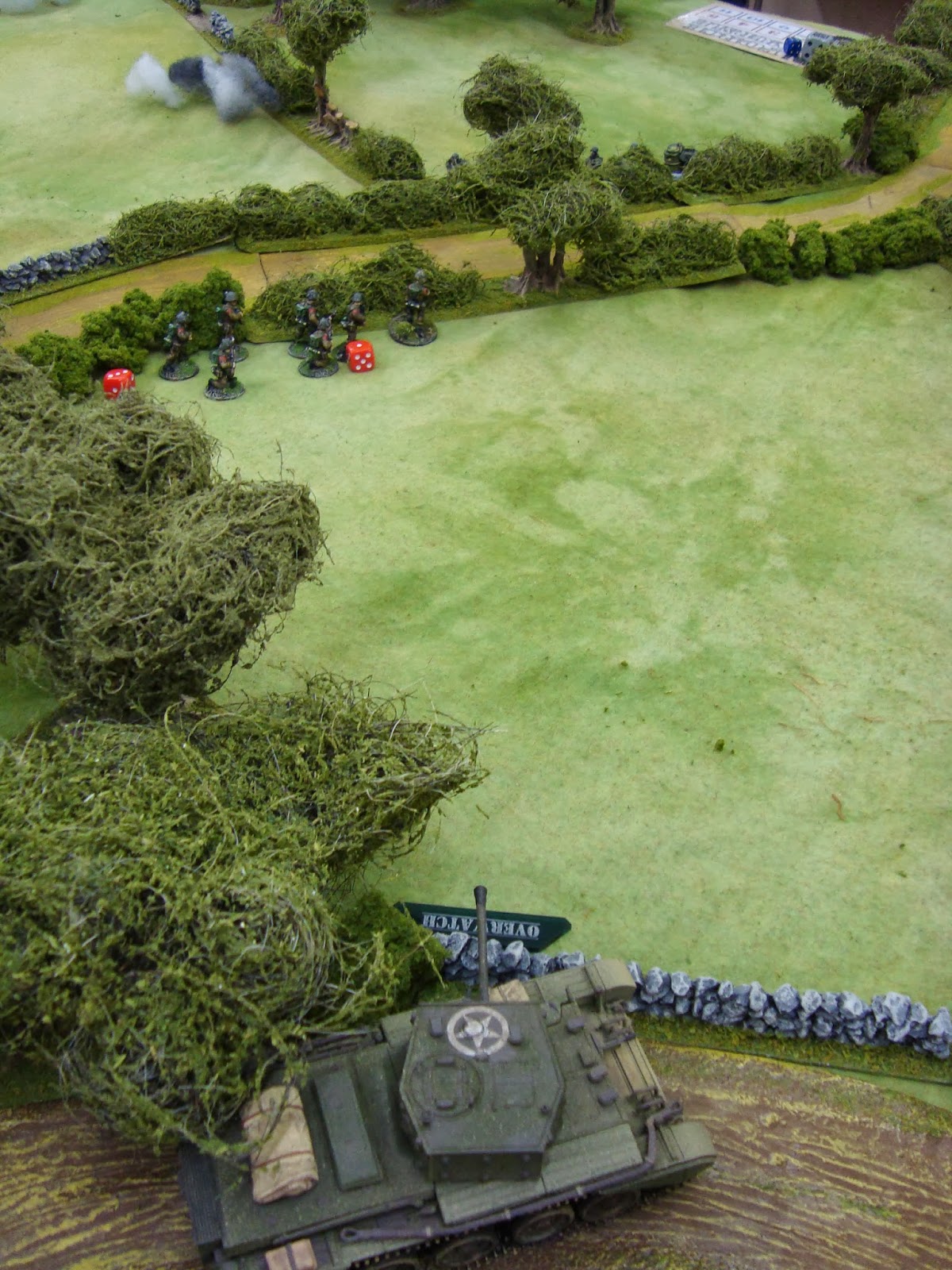
The third game in out Chain of Command campaign saw the British assault on Hill 113 bog down as miserably as Sergeant Evans' attempt to cross the Normandy stone wall into "Les Trois Vaches" farm.  

Although the British has a full platoon and a Cromwell tank in support, making progress against a German platoon and a fine defensive position can still be hard work.  The luck favoured both sides fairly easily, but the British assault was broken eventually by the inability of the Cromwell to effectively fire on the German defenders on account of the smoke liberally peppering the battlefield from the British 2" mortars!  A salutary lesson for any would-be Royal Engineers on a wargames table!

The game was a lot of fun, and as we're playing through Richard's campaign supplement we're finding quite a few things developing.  First, both sides are more cautious in approaching defensive positions, mainly out of respect for the effect of bi-pod mounted machine guns in strong positions.  Second, both sides are probing first and hitting once the enemy are discovered - we're trying to follow the tactics laid down in the military manuals of the time (thoughtfully supplied by Richard to the players).  Third, some of the characters formerly thought of as utter duds are coming good.  To my amazement, Second Lieutenant St Clair is finding his feet in the campaign - which is a great pleasure considering he was first rolled up to test the effect of a "shell-shock rule"!

The campaign supplement is developing well.  The initial focus on trying to create a combat stress, or "shell-shock" effect is evolving into a much more interesting character development track.  more of that on Lard Island News HERE.

At the same time, there are, of course, inevitable twists of fate.  Panda's dice rolling continues top be a thing of wonderment, as you can see here.  


Even the best laid schemes can "gang aft agley", no doubt as Second Lieutenant's Uncle would have told him in that cold, dark salmon-empty Perthshire river in that lifetime before the War.
Friday, 4 October 2013

The Verdun Project: Tirailleurs Marocains and Artillerie Speciale


One of the things I promised myself when starting a Late Great War French army is to make sure that I didn’t have a lot of random figures left at the end of the project. I turned out to be more than slightly over-optimistic in this regard. When I ordered the figures for the French infantry at the start of the year from Brigade Games, I over-ordered. Partly this was the usual rush of enthusiasm, and partly this was because I wasn’t quite sure how many formations I was going to build and I wanted to combine the orders into as few parcels as possible to save shipping.

I was left with a couple of dozen figures at the end of the project. Rather than file these I a drawer and forget about them, I cast around for a way to use them which didn’t involve painting them as basic infantrymen. Here’s where I got to.

Three have been enlisted into the ranks of French tank crews from the Artillerie Spéciale – more of this to come later this year, but suffice to say that I’ve purchased enough French tanks to form a small force from the Nivelle Offensive at Berry-au-Bac in April 1917. I’m hoping to paint these up in November and December, so watch this space. Sadly, only one manufacturer makes French tank crew – which are the Old Glory figures featured here. This is a great shame as the heroics of the French Artillerie Spéciale are inspiring and very interesting material for any game. Anyone wanting French tank crewmen with British Tank-Corps style face masks (such as the one shown in the Osprey French tanks of World War One volume), has to resort to green- or brown-stuff versions.


The wounded/ shock markers are from generic casualty figures I bought a while back from Silent Invader at the Lead Adventure Forum. Regular visitors to this blog might remember these from British and German casualty projects in the past.


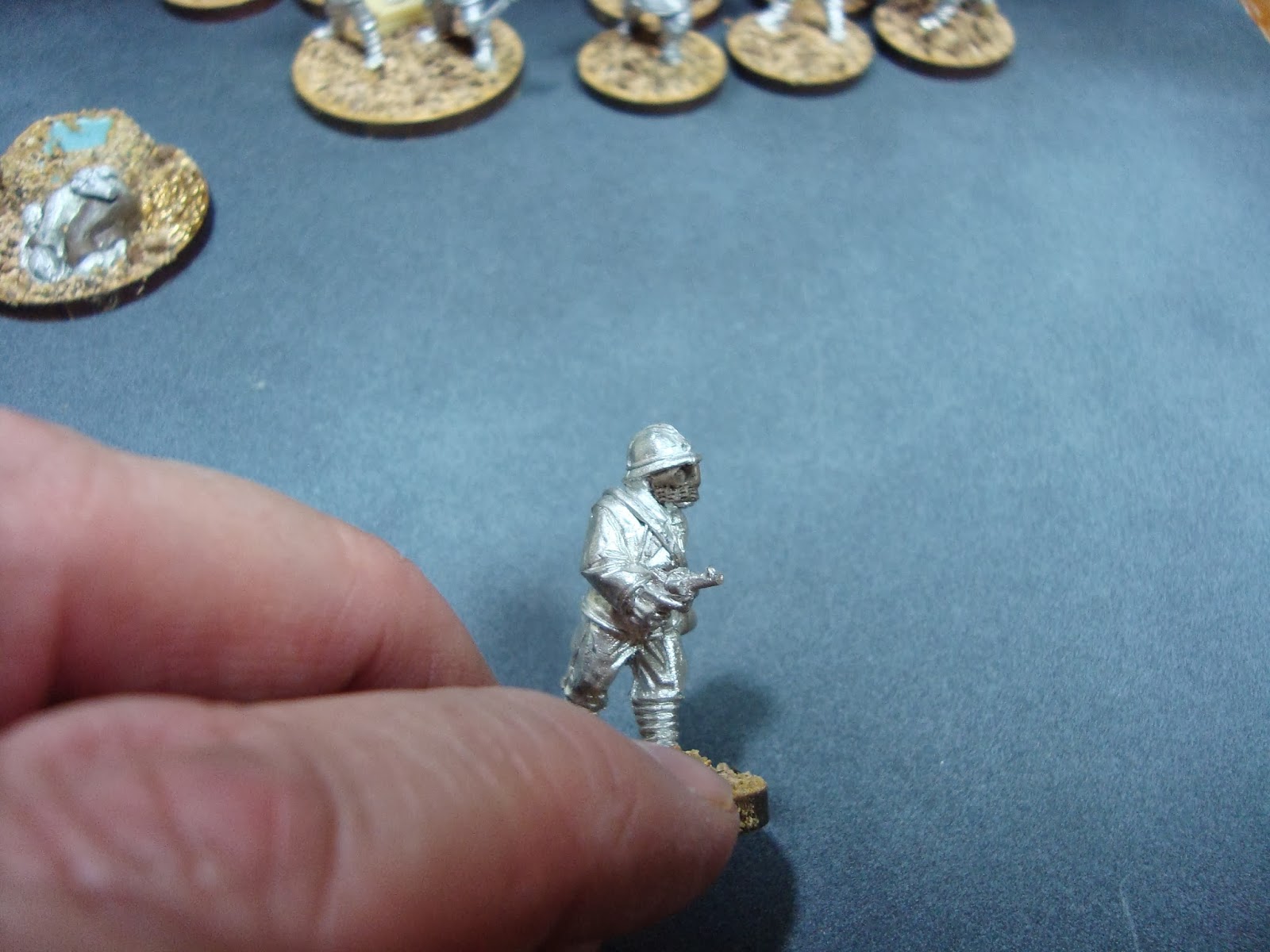
The remaining figures eleven figures I converted as Tirailleurs Marocains, using the Woodbine miniatures’ Zouave heads. I was really pleased how easy these were to use. Simply saw off the head of the figure, drill a hole and insert the new head. I added a collar of brown-stuff on most of the figures to disguise the join. I sawed off the helmets as well and added these to the Zouaves’ field packs to try and give the figures a Late War “feel”. I’m very much aware that any sensible Tirailleur would have worn his Adrien helmet in action, and depicting the Zouaves in their dress caps is probably viewed by many as a crazy affectation. I admit it – you’re right. It’s unhistorical, but I liked the appearance. And since I’m unlikely to do an Early War French army any time soon, this was my only chance. So, confession over, here’s how they lined up post-conversion:


You may be wondering what on earth I am going to do with just eleven Tirailleurs Marocains!!

It’s a fair question, mes braves, but I’m sure there’s a scenario they can fit into. Perhaps as a group of Tirailleurs pinned down in No Man’s Land, or as a bunch of stragglers, or as a scouting patrol. I’d not be surprised if they end up being used more than the typical Pinard-drinking Poilu!

And why the Tirailleurs Marocains in particular?  Almost entirely because some of the Moroccan regiments seems to have been equipped with Horizon Bleu uniforms throughout the war, as opposed to being equipped with khaki uniforms (as were more common for the French African regiments). That, and they offer just a glimpse of the huge contribution to the French war effort made by African soldiers in the Great War. With that in mind, it was very hard to resist their allure for the wargames table....


I’ve still got a platoon of Tirailleurs Sénégalaise to paint, but they’ll be lucky to get painted this side of Christmas.

Next up will be the next instalment In our Chain of Command Campaign, so here’s hoping you can join me for that. Have a great weekend!

Monday, 23 September 2013

Chain of Command Campaign: Game 2 – “Probe”


Morning. Early. Normandy. Late June or even July 1944.

He really had no idea of the date. He’d stopped trying to remember. The grey numbness at the back of his head halted the effort as soon as he started to think. He knew it was early, though. Definitely early, even without looking at his watch. He checked it, reassuringly, all the same.

Second Lieutenant Sandy St Clair stared at his watch longer than most men would. While his bloodshot eyes registered the seconds ticking past, he realized this was one of the few moments when his hands had stopped shaking in the past month. Maybe that was why he looked so often. Maybe there was another reason.


++++++++++++++++++++++++++++++++++++++++++++++++++++++++++

2nd Platoon under Second Lieutenant St Clair will advance up the road to Aurade, moving at all times to outflank enemy forces and infiltrate through the light woods north west of Aurade (Map Reference: N427604). Enemy forces in this area are currently reported to be determined but potentially short of ammunition and falling back to the Aurade/ Aubigny defence-line. 2nd Platoon will be reinforced by a company bren carrier commanded by Sergeant Hodge. 

 
+++++++++++++++++++++++++++++++++++++++++++++++++++++++++++

As ever, he could smell the battlefield before he was there. The days old scent of dead cattle and horses, still heaving with flies. He didn’t look in the ditches any more. He knew what he’d find there. His hands shock as he took the field glasses out to scan the rising downland before him. He knew his men were watching. He moved his arms, circling widely to advance. Maybe they would not notice his hands, white knuckles gripping just that shade too hard.

5.17am . But his knew his watch was a liar. It really couldn’t be that time. It was wrong. Look again.

+++++++++++++++++++++++++++++++++++++++++++++++++++++++++++

2nd Platoon is to press aggressively through Enemy resistance and infiltrate Enemy defences around Aurade. This task is critical to the success of the Company’s mission this morning.

+++++++++++++++++++++++++++++++++++++++++++++++++++++++++++

Somewhere someone whispered to him. “They’re off Sir”. He looked, hands less shaky now, watching the first section running across the open field, the chemical smoke dropping neatly as planned. It was like an exercise on Nomansland Common the previous year, without the crowds watching and the horses stacked in the paddock by the side, smiling faces admiring the discipline and precision. Another lifetime ago, when it all seemed so far removed from the real fight.


They’d seen the first section. Of course. They always did. He almost smiled. How familiar. Almost predictable. The rasp of the MG42 ripped the air and he saw his men fall. He screamed. He wanted to shout “Smoke””, but it was a howl, half ruptured by his bone dry throat.


++++++++++++++++++++++++++++++++++++++++++++++++++++++++

Our forces are expected to press hard this morning, as it is reported by Brigade that Enemy morale is fragile and may be close to collapse.


+++++++++++++++++++++++++++++++++++++++++++++++++++++++++

The field was carved by ploughs and old shrapnel. The gullies and troughs made good cover. He crawled, slithered and crouched to the opening in the stone wall, jabbing constantly for his men to follow him. His head was flooded with a white noise and he could hardly see as he made it to the far wall. He stared at his watch, spattered with blood flung randomly through the damp air, spattering his skin. His section’s bren gunner, McKie, was dead. McKie’s death-pale white face slumped down beside him, eyes wide open. McKie stared back at him, and it was all that Second Lieutenant St Clair could do to focus on his watch and scrape the blood flecks away.  The blood left a smear on the face of the watch.


As the MG42’s bullets wheezed and threshed into the stone wall, splinters whickering into the still-damp morning air, Hodge’s bren carrier moved haltingly down the road, accompanied by the crump and thud of the mortar shelling the Enemy’s position in the orchard. He waved them up as best he could, limbs numb and hands shaking. He even managed a grim smile to Hodges as he clattered past. See...SEE….he was still fit for duty.  He could still face his friends in the battalion.  His "moral fibre" was intact.


The Enemy had ghosted away, leaving a litter of ammunition, explosives and 12 crumpled dead bodies. Two of them looked almost like children, sleeping, face down in their camouflage smocks, helmets tilted at an angle, necks cricked awkwardly.

He didn’t want to turn over their dead bodies. He looked at his watch, wiping the remnants of McKie’s blood smear from the dial.  Still fit for duty.

5.32am. Still early. The day had just started.

+++++++++++++++++++++++++++

This was the second of our campaign games of Chain of Command set in Normandy 1944. It turned out to be a tough affair, in which the losses of the previous, first, game were sorely felt by the Germans. The British were tasked with probing up the road to Aurade, having a full platoon and a bren carrier (chosen from their force support list). The Germans, with fewer men after their previous defeat, only had two sections, although they commanded the high ground and a strong position.

An early British assault over open ground (resulting from a Chain of Command roll offering a second phase on two “6s”) led to disaster with the section being slaughtered without being able to reach the protection of the stone wall at the top of the hill. Following the setback, British forces were more cautious, pinning the remaining German forces and outflanking them in a cautious manner. The Germans’ lack of troops made the position untenable, their forces stealing home and leaving the table to the British.


That leaves the British having infiltrated the German outpost line and ready to concentrate their attack against more formidable German defences in this week’s game.


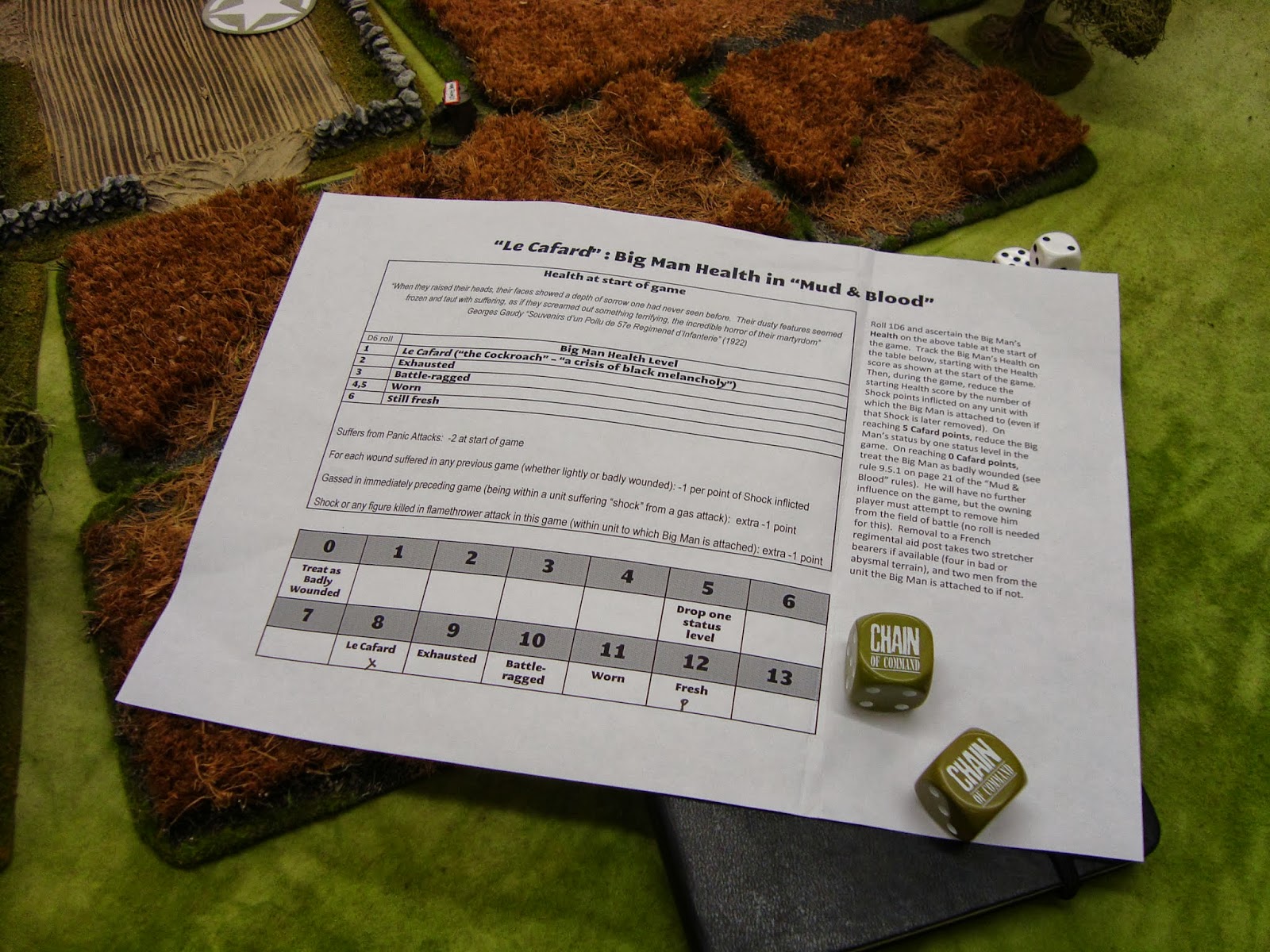
We also tried out a new possible feature for the Chain of Command campaign supplement. The 5-second elevator pitch is “a system for Leader Morale which complements the Force Morale system in the rules”. It’s early days yet, but I’ve been working with Rich on a set of very simple amendments to try and replicate the effect of building combat stress, “shell-shock” and disorientation on one leader on each side in a game. While this very much fits the context of the First World War, I think that it’s application can extend to the Second World War as well. The Chain of Command level of games is perfect for this type of (completely optional) detail. The mechanisms need some tweaking, but I think we’ll persevere with this in later campaign games.
Related Posts Plugin for WordPress, Blogger...